
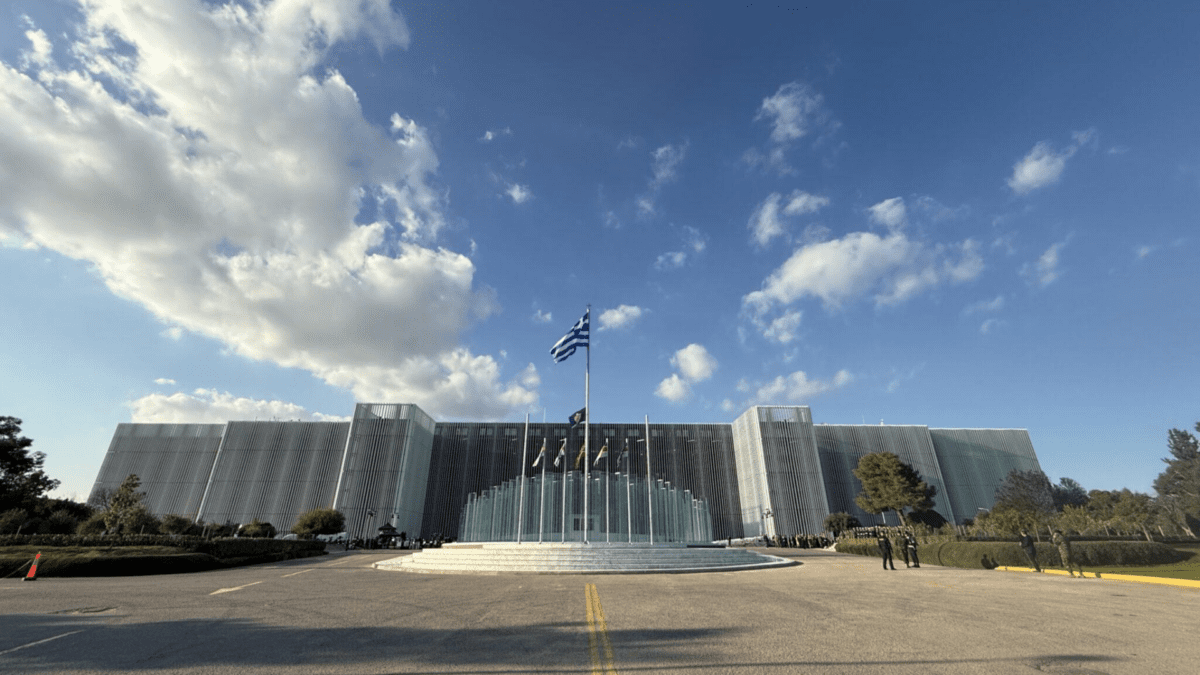
Greece is turning an ancient symbol into a modern defence doctrine. The “Achilles Shield” project, promoted by Defence Minister Nikos Dendias under Greece’s Agenda 2030, aims to connect land, sea, air, cyber and space into one security network. Athens does not present it as a simple procurement plan. It presents it as a new military posture for a region where drones, missiles, satellites and maritime power now shape old disputes.
The project comes as Greece enters one of its largest military modernization cycles in years. In March, a Greek parliamentary committee approved a package worth about €4 billion. It included a roughly €3 billion air and drone defence system, along with the upgrade of 38 F-16 Block 50 aircraft to the Viper standard. Greece also plans a wider defence program that could reach about €28 billion by 2036.
For Athens, the logic is defensive. Greece faces the effects of the war in Ukraine, rising drone threats, missile proliferation and tension in the Eastern Mediterranean. However, the project also carries a clear regional message. Greece and Türkiye are NATO allies, but they remain divided by maritime boundaries, airspace, the militarization of islands, energy rights and Cyprus. As a result, every missile system, naval upgrade or satellite project carries political weight beyond its technical role.
For Ankara, the Aegean and the Eastern Mediterranean are not just maritime areas. They are strategic depth. Türkiye’s Blue Homeland doctrine treats maritime jurisdiction, continental shelf claims, energy routes and the security of Northern Cyprus as core national security issues. Therefore, Ankara will watch Achilles Shield closely. Greece may describe the project as defensive. Türkiye may see it as part of a wider attempt to shift the military balance in the Aegean and the Eastern Mediterranean.
The Aegean dispute already includes several unresolved files. First, Türkiye points to continental shelf delimitation, territorial waters, airspace, FIR arrangements and the demilitarized status of the Eastern Aegean islands. In addition, Ankara says Greece violates international agreements by militarizing certain islands. Athens, however, says it needs that posture for self-defence. As a result, the gap in perception matters. One side sees deterrence. The other, meanwhile, sees pressure.
Cyprus makes the picture even more sensitive. Türkiye argues that energy and maritime arrangements in the Eastern Mediterranean cannot ignore Turkish Cypriot rights. Ankara also rejects unilateral offshore energy moves by the Greek Cypriot administration. It says those steps disregard Turkish Cypriot interests and challenge Türkiye’s own maritime claims.
Meanwhile, Greece and the internationally recognized Republic of Cyprus see stronger defence cooperation as part of regional security. Türkiye and Northern Cyprus, recognized only by Ankara as the Turkish Republic of Northern Cyprus, view the same cooperation differently. They see a regional order that may exclude Turkish Cypriot interests. In practice, Achilles Shield becomes more than a Greek defence program. It becomes part of a wider equation involving Türkiye, Greece, Cyprus, Israel, NATO, the EU and energy security.
The strategic case for rearmament is clear. The economic cost is harder to manage. Greece still carries the memory of its 2009–2018 debt crisis. Large defence programs can support domestic industry, attract technology partnerships and strengthen local production. However, they also create fiscal pressure.
Achilles Shield, F-16 upgrades, frigate modernization, rocket artillery talks, submarines, drones, satellites and planned F-35 purchases all point in the same direction. Greece is entering a long and expensive defence cycle. The country already spends about 3% of GDP on defence, almost double the EU average. It also plans more than €25 billion in arms procurement by 2036.
That creates a difficult trade-off. Defence spending can improve deterrence. Yet it also competes with infrastructure, energy transition, healthcare, housing and productivity investment. The problem is not only that Greece is spending more on defence. Many European countries are doing the same. The bigger risk is that imported systems from Israel, the United States and other suppliers increase the fiscal burden without building enough domestic industrial capacity.
If Greek companies secure only a limited share of production, the economic multiplier will stay weak. If local participation grows, the program could support jobs, technology transfer and a stronger defence-industrial base. That difference matters. Rearmament can become a long-term industrial strategy. Or it can become a costly import cycle.
Achilles Shield shows where European security is heading. Defence is becoming more technological, more expensive and more closely linked to economic policy. For Greece, the project offers stronger deterrence and greater military resilience. For Türkiye, it will sit inside the wider debate over Blue Homeland, the Aegean disputes, Cyprus and the balance of power in the Eastern Mediterranean.