
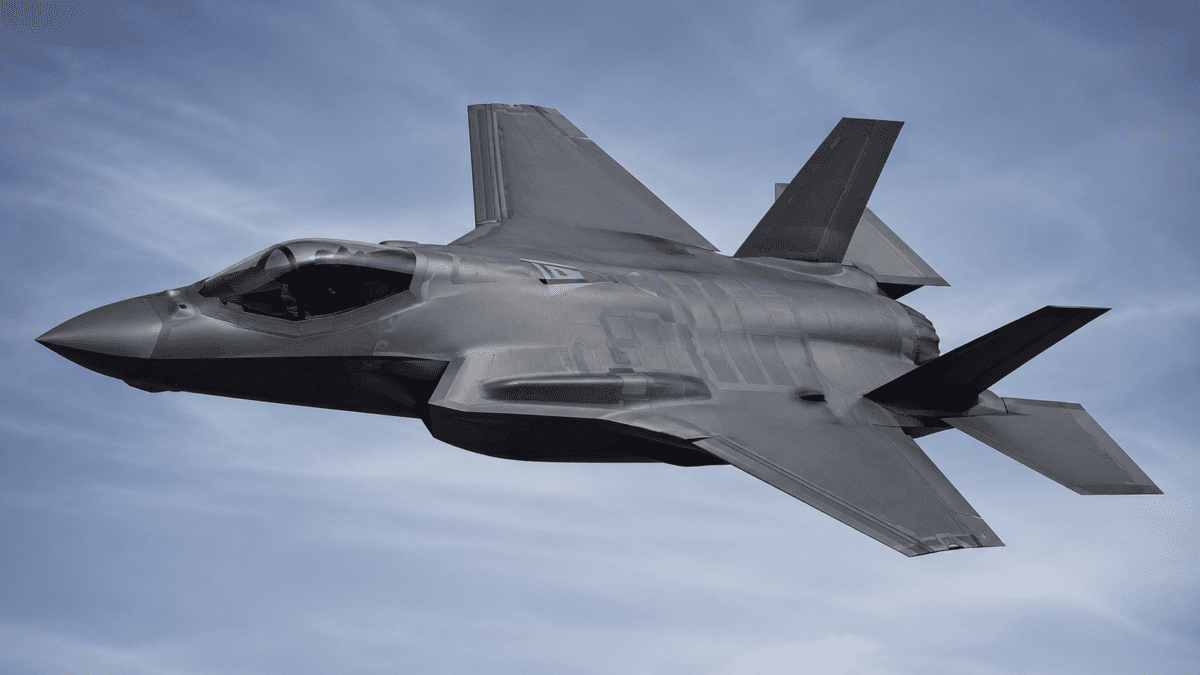
Britain’s F-35 program has reached an awkward point. The government can say the first major procurement batch is complete. But the harder question is whether enough of those aircraft can actually be kept ready for combat.
That question became sharper after reports that two newly built British F-35B Lightning II jets were forced to land in the Azores during their delivery flight from the United States. The aircraft, part of the final group linked to Britain’s first 48 F-35s, reportedly developed technical problems after leaving Lockheed Martin’s Fort Worth plant in Texas. Instead of reaching RAF Marham in Norfolk, they remained grounded at Lajes Airport on Terceira Island.
The incident matters because Britain had already presented the completion of its first 48-aircraft F-35B package as a major milestone. On paper, the program had crossed an important threshold. In practice, the final two jets had not reached the United Kingdom.
The real issue is usable combat power
This is not only a story about two aircraft stuck in the Atlantic. It points to a wider problem in Britain’s fast-jet force: the gap between aircraft acquired and aircraft available.
The F-35B is central to British carrier strike power. It is operated jointly by the Royal Air Force and Royal Navy and is the only variant able to fly from Britain’s Queen Elizabeth-class aircraft carriers. Its short take-off and vertical landing capability makes it essential for the UK’s maritime air strategy.
But that same variant is technically demanding. The F-35B is more complex than the conventional F-35A, and its maintenance burden is heavier. For a force with limited aircraft numbers, limited engineering depth and high operational demand, that becomes a strategic constraint.
Britain has already lost one F-35B in a 2021 carrier accident. Of the original 48-aircraft batch, that leaves an even tighter usable fleet. If aircraft are delayed, grounded, awaiting parts or undergoing upgrades, the headline number becomes less important than the mission-capable number.
A known readiness problem
The UK’s own oversight system has already warned about this. Britain’s F-35 fleet has struggled with availability, spare parts, infrastructure and personnel shortages. Reports have also pointed to delays in integrating key UK weapons, including the SPEAR 3 air-to-ground missile and Meteor air-to-air missile.
That creates a capability problem. Britain has a stealth aircraft designed for high-end conflict, but parts of the weapons and support ecosystem needed to exploit that aircraft fully are still catching up.
The issue is not unique to Britain. The wider F-35 program has faced recurring sustainment pressure across partner nations. Spare parts supply, software upgrades, maintenance complexity and global fleet demand all affect readiness. But the problem is sharper for the UK because its F-35B fleet is expected to serve both land-based RAF missions and carrier operations.
Operational demand is rising
The timing is difficult. Britain is asking more from the F-35 fleet at the same moment availability remains under pressure.
RAF F-35Bs have been used in live operations in the Middle East, including the interception of hostile drones. The aircraft has also supported carrier deployments with HMS Queen Elizabeth and HMS Prince of Wales. These missions prove the aircraft’s value, but they also increase wear, maintenance cycles and logistical strain.
The grounding of a British F-35B in India in 2025 showed the same vulnerability. After diverting during bad weather and suffering technical issues, the aircraft remained at Thiruvananthapuram International Airport for weeks before it could be repaired and flown out. The Azores case now adds another visible example of how difficult it can be to recover a highly complex stealth jet once it is stranded away from its main support base.
The F-35A decision adds another layer
Britain’s next procurement step also changes the debate. London has moved toward buying additional F-35s, including 12 F-35A aircraft. The F-35A is cheaper than the F-35B and can support NATO’s nuclear mission, giving Britain a renewed air-launched nuclear role within the alliance.
But the F-35A cannot operate from British carriers. That means the decision strengthens NATO nuclear integration but does not directly solve the carrier air wing problem. If Britain wants more aircraft for carrier strike, it still needs more F-35Bs or a different long-term solution.
This is where the trade-off becomes clear. The F-35A adds strategic value. The F-35B preserves carrier power. Britain needs both, but budget, manpower and sustainment capacity are not unlimited.
The strategic problem
The F-35 gives Britain stealth, advanced sensors, electronic warfare capacity and deep integration with US and NATO systems. It is a major leap over older platforms. It also supports British industry, since UK companies produce a significant share of components for every F-35 built.
But advanced aircraft do not create air power by themselves. Air power comes from aircraft, weapons, pilots, engineers, spare parts, software, basing infrastructure and maintenance capacity working together.
That is where Britain’s F-35 program remains exposed.
The two jets stuck in the Azores are not the whole story. They are a symbol of the larger issue. Britain is building a high-end combat air strategy around the F-35, but the support system behind that fleet remains under strain.
The result is a familiar defence problem: impressive capability on paper, limited readiness in practice.
For Britain, the next test is not whether it can buy more F-35s. It is whether it can turn the aircraft it already has into reliable, deployable combat power.