
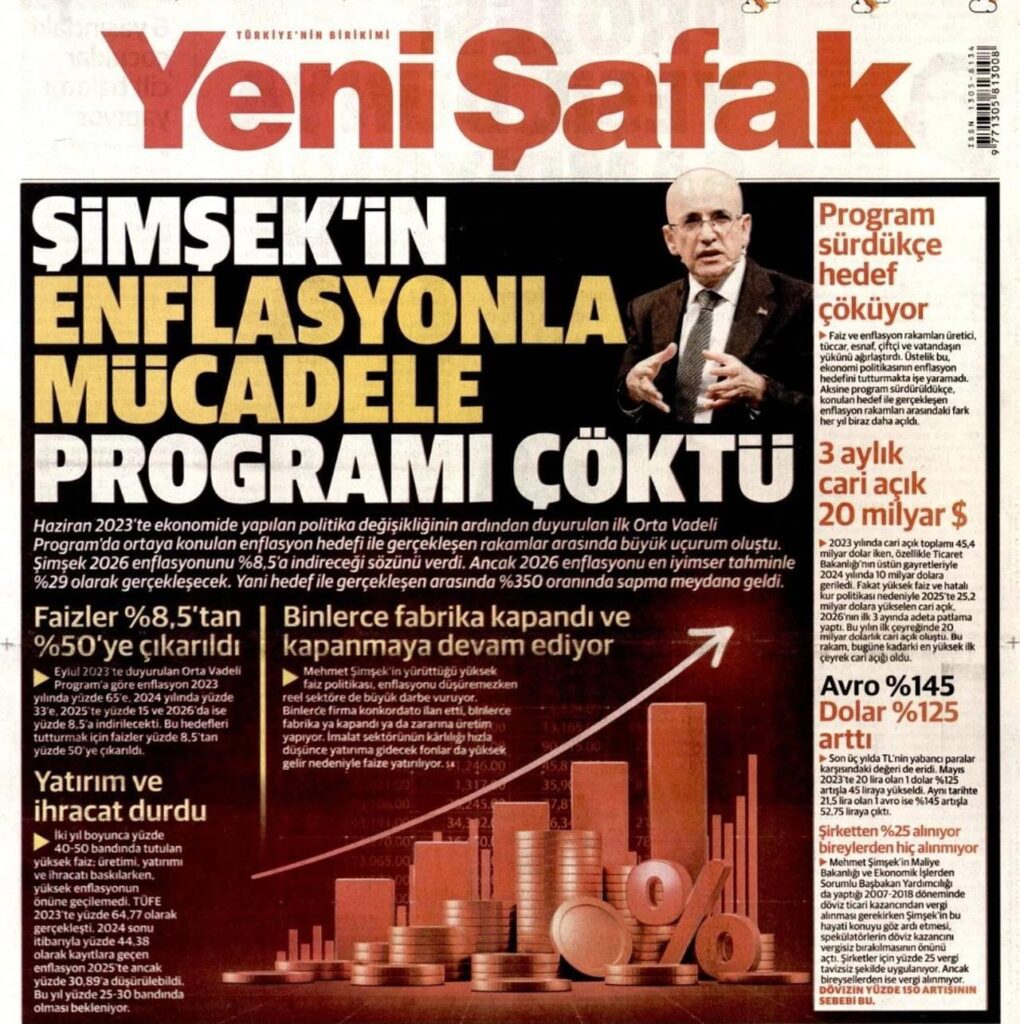
A front-page headline in Yeni Şafak, a daily newspaper closely aligned with Turkey’s ruling party, openly questioned the credibility of the country’s economic program this week.
The target: Finance Minister Mehmet Şimşek and the disinflation strategy he has led since mid-2023.
For a publication with Yeni Şafak’s political alignment, that is not a routine editorial position.
The Gap Between Targets and Reality
The criticism is grounded in numbers. Turkey’s Medium-Term Program set out a clear path when it launched: inflation falling from 65 percent in 2023 to 33 percent in 2024, then 15 percent in 2025, before reaching single digits by 2026.
The 2026 year-end target now sits at 16 percent. Nearly double the original projection. Actual inflation remains above 30 percent as of March 2026.
The deviation is not a rounding error. It is a structural gap between what the program promised and what the economy delivered.
Rates Rose. Inflation Didn’t Fall.
Turkey’s policy rate climbed from 8.5 percent in May 2023 to 50 percent by March 2024, one of the most aggressive tightening cycles in the country’s recent history. It has since eased to around 37 percent.
The result has been limited. Inflation remains elevated, and the cost of tight policy is increasingly visible in the real economy. Businesses are scaling back production, seeking financial restructuring, or shutting down entirely.
The Lira Keeps Weakening
Currency depreciation has compounded the problem. Since mid-2023, the dollar has climbed from around 20 lira to approximately 45. The euro has moved from just above 21 to over 52.
Each depreciation cycle feeds directly into import costs, which feed into prices, which undermine the very disinflation target the policy was designed to achieve. The loop is not broken.
Progress That Did Not Hold
The external balance has delivered mixed signals. The current account deficit narrowed sharply to around $10 billion in 2024, down from over $45 billion the year before. That improvement was cited as evidence the program was working.
It did not last. The deficit widened again to over $25 billion in 2025. In the first quarter of 2026 alone, the gap has already reached roughly $20 billion, pointing toward a much larger annual shortfall if the trend holds.
Why the Source Matters
The economic argument is significant. The source is more significant.
Yeni Şafak has operated as a reliable voice for the ruling Justice and Development Party’s position for years. A front-page attack on the finance minister’s flagship program from that outlet signals something beyond editorial independence. It signals internal pressure.
Whether this reflects a temporary shift in tone or a deeper change in how the government’s inner circle views the economic program remains unclear.
What is clear is that Turkey’s inflation fight is entering a more contested phase, and the criticism is now coming from directions the government cannot easily dismiss.