
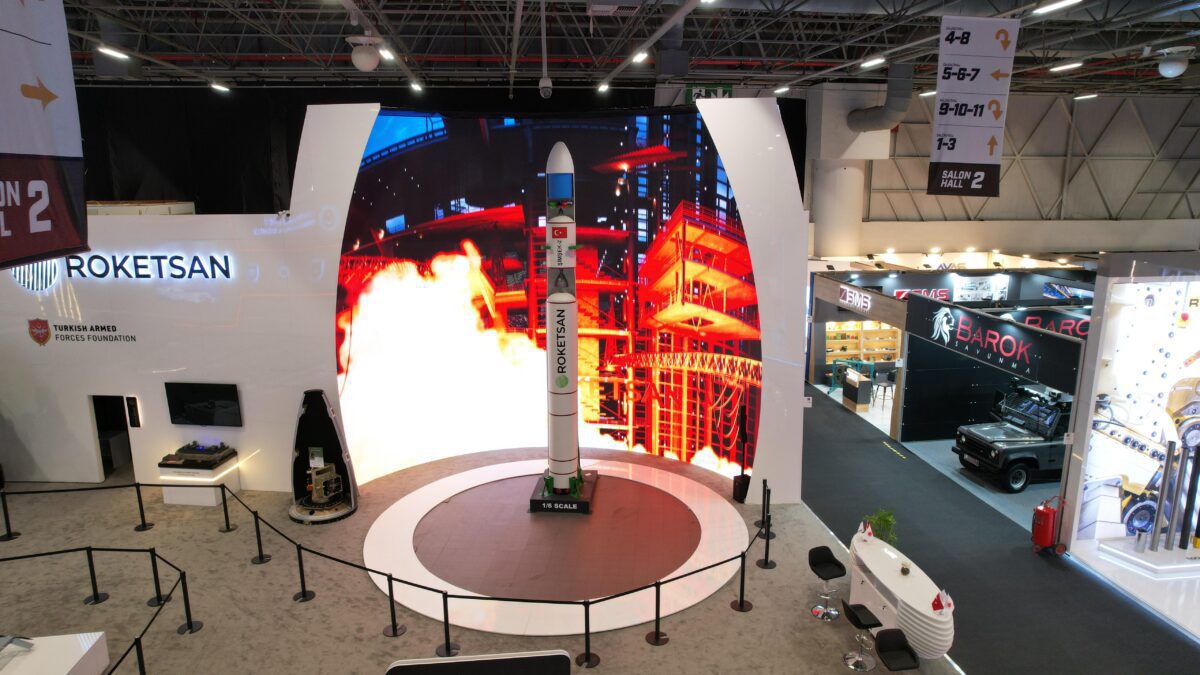
Turkey’s investment in long-range missile technology, air defense systems and domestic defense production points to a wider shift in Ankara’s security strategy. This shift is not only about military capacity. It is also about high-tech manufacturing, exports, industrial depth and regional deterrence.
The long-range ballistic missile project known as Yıldırımhan has become one of the most visible symbols of this change. It suggests that Turkey is no longer focused only on short-term security needs, but also on long-term strategic capability. Still, an important distinction is needed. Yıldırımhan should not yet be treated as an operational power asset. It is better understood as a signal of the advanced defense engineering capacity Turkey aims to build.
In that sense, the issue is larger than a missile program. Turkey is trying to create a defense architecture that can respond to surrounding security risks without depending heavily on external suppliers.
Defense industry has become part of economic strategy
Turkey’s defense industry has moved beyond traditional military production. Unmanned aerial vehicles, precision munitions, radar systems, electronic warfare technologies, air defense components and command-control software now matter not only for the armed forces, but also for exports and technological capacity.
This growth supports the Turkish economy through multiple channels: creating high-value export potential, strengthening domestic engineering capacity, and expanding a wider supply chain of subcontractors, small and medium-sized companies, and technology firms.
For this reason, defense investment should not be viewed only as budget spending. If planned carefully, it can generate knowledge and industrial capability that may later spread into civilian sectors, from engine technologies and software to sensors, materials engineering and advanced manufacturing.
Russia, Iran and Syria are reshaping Ankara’s security calculations
Turkey’s faster defense push cannot be separated from its surrounding geography. To the north, the Russia-Ukraine war continues to affect Black Sea security. It has also increased Turkey’s strategic importance for energy routes, grain corridors, maritime trade and NATO’s eastern flank.
To the east, Iran is not only a neighboring state. Its missile capacity, regional influence networks and role in Middle Eastern power competition make it a constant factor in Turkey’s security planning. Tensions involving Iran and Israel also show how quickly regional instability can move across borders.
To the south, Syria remains an unfinished crisis zone. Fragmented state authority, terrorism risks, border security, migration pressure and the presence of foreign powers continue to shape Ankara’s long-term defense planning.
This environment helps explain why Turkey is investing in stronger air defense systems, more advanced missile technologies and a more independent defense production base. For Ankara, defense industry is no longer only about deterrence. It is also about strategic autonomy.
Regional balance requires strength and restraint
Turkey’s growing defense capacity can become an important balancing factor in the region. But its value depends on how that power is positioned. Deterrence matters when it helps prevent crises from expanding, not when it fuels new tensions.
That is why Turkey’s defense push should be framed not as an aggressive turn, but as part of a security strategy built around stability. Ankara’s NATO membership, its diplomatic role in the Black Sea, its channels of communication in the Middle East and its domestic defense production goals all operate within the same strategic equation.
As the region becomes more unstable, Turkey’s main advantage is not military technology alone. Its real leverage comes from combining defense capability with economic production, diplomatic flexibility and strategic patience.
Atatürk’s principle still matters
Atatürk’s principle of “Peace at home, peace in the world” remains relevant in today’s security environment. It does not mean passive foreign policy. It means that state power should serve the protection of peace.
Turkey’s defense industry gains its strongest meaning within this framework. Stronger air defense, long-range deterrence, domestic engineering and technological independence can create lasting value only when they are paired with a measured and peace-oriented foreign policy.
Yıldırımhan and similar projects are therefore not only military programs. They are part of Turkey’s effort to build economic capacity through defense production, act with greater independence in a crisis-heavy region and play a more effective role in regional balance.
The conclusion is clear. Turkey is entering a more ambitious phase in defense policy. The real strength of that ambition will not be measured only by range, technology or production figures. It will depend on economic sustainability, diplomatic balance and a strategic mind that keeps peace at the center.