
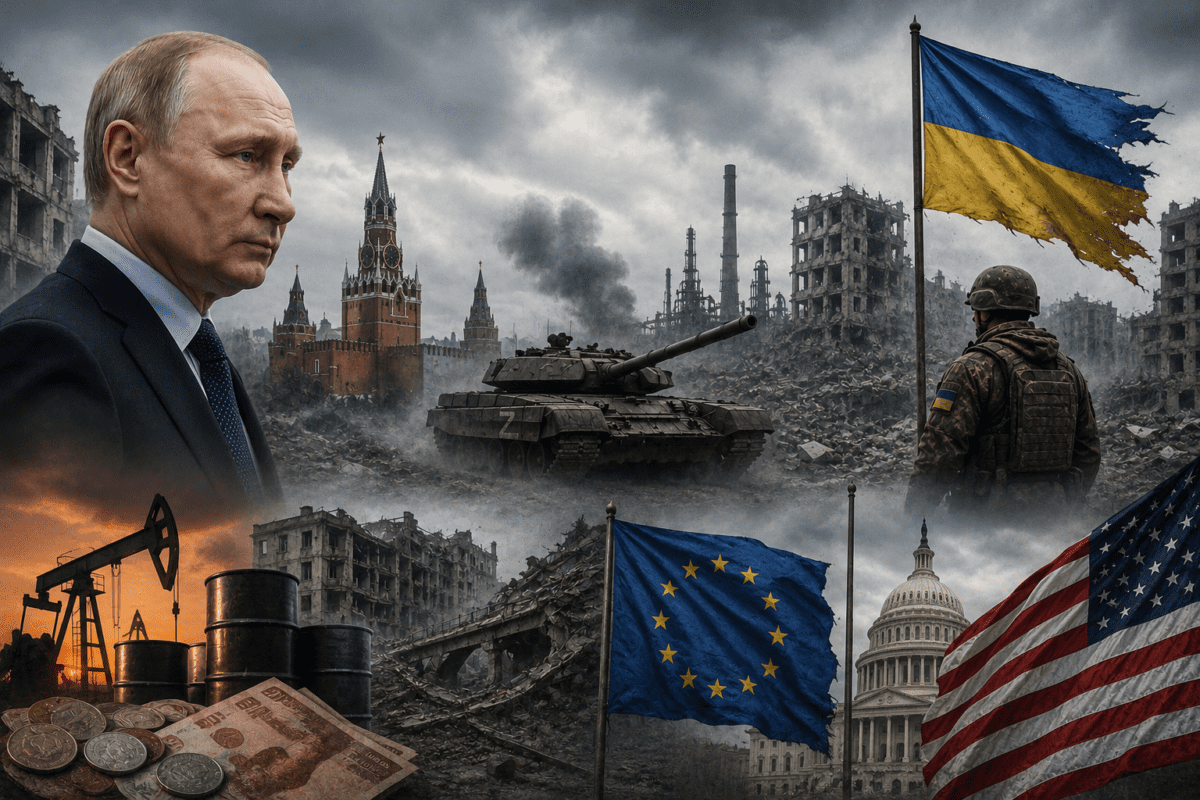
Russia has not collapsed under the pressure of the Ukraine war. That matters. But survival should not be confused with victory.
More than four years after the full-scale invasion, the war has settled into a costly stalemate for every major actor around it. Russia has kept its economy running. Ukraine has avoided defeat. Europe has absorbed a long energy and security shock. The United States has spent heavily while facing growing political fatigue over continued support.
This is not a war with a clear winner. It is a war that has shifted costs from one economy to another.
Russia’s economy performed better than many early forecasts expected. After the shock of 2022, growth returned in 2023 and 2024, supported by state spending, military production, oil revenue and redirected trade flows. The Kremlin proved that sanctions alone would not quickly break the system.
But the price of that resilience is visible. Russia’s economy is now more dependent on defense orders, state intervention, labor mobilization and energy income. Growth slowed sharply in 2025, while forecasts for 2026 point to only limited expansion. The wartime model still functions, but it no longer looks like a source of durable strength.
The question is no longer whether Russia can keep operating. It can. The question is what kind of economy is operating. A healthy growth cycle creates productivity, investment and consumer confidence. Russia’s war economy creates weapons, subsidies, labor shortages and fiscal pressure. That is not collapse, but it is not strategic success either.
This creates a deeper political problem for Vladimir Putin. The war began as a demonstration of Russian power. It was supposed to show that Moscow could reshape Europe’s security order by force. Instead, it has become a long war of attrition with no clean victory stage.
Putin still controls Russia’s political system. He can still project authority at home. But the image of the decisive leader has been damaged. He needs a narrative that presents him not only as a survivor, but as the man who restored Russian power. At the moment, that narrative is difficult to build.
Ukraine has not surrendered. NATO has expanded. Europe is spending more on defense. Russia is closer to China, but also more dependent on it. None of this gives Putin the simple strongman success story he needs. His strongest message is no longer victory. It is endurance.
Ukraine can also claim survival, and that is significant. Russia failed to erase it as a sovereign state. Kyiv still receives Western support, still imposes costs on Russian forces and has become central to Europe’s security architecture.
But Ukraine’s survival has come at enormous cost. Its economy, infrastructure, energy system and population have been damaged deeply. The country remains dependent on external financing and military assistance. Even if the war stops, Ukraine faces years of reconstruction, fiscal strain and demographic pressure.
Europe is paying its own long bill. It lost cheap Russian energy, rebuilt supply routes, subsidized households and industries, increased defense budgets and financed Ukraine. Energy prices have eased from their 2022 peaks, but the shock changed Europe’s cost structure. For manufacturing, heavy industry and households, the damage did not simply disappear.
The United States gained leverage, but not a clean win. Washington weakened Russia without sending American troops into direct combat. It reinforced NATO and increased demand for U.S. energy and defense exports. Yet the war has also consumed ammunition stocks, political attention and fiscal resources. It has pushed Russia deeper toward China and made long-term Ukraine support a domestic political fight.
The Ukraine war is now a test of endurance. Russia can keep fighting, but its economy is more distorted. Ukraine can keep resisting, but its reconstruction bill keeps rising. Europe can keep supporting Kyiv, but the cost is structural. The United States can keep shaping the war, but patience is thinner.
So the argument that “Russia is losing” needs precision. Russia is not losing in the simple sense of collapse. But it is not winning in the strategic sense of becoming stronger, richer or safer.
Russia survived the war economy. Ukraine survived the invasion. Europe survived the energy shock. The United States survived the financial burden.
But survival is not victory. For Putin, that may be the hardest problem. A leader who built his image on strength now presides over a war where the best available message is that Russia has not yet broken.