
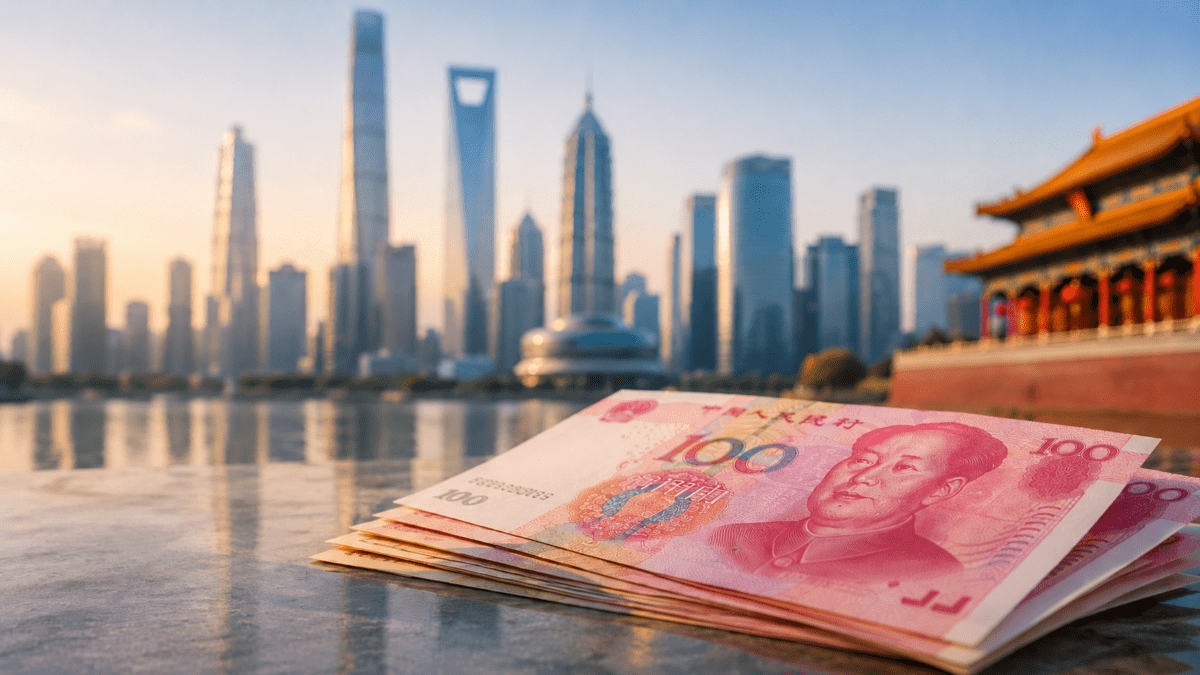
Goldman Sachs is putting a sharper number on a broader market reality. The Chinese yuan may be too weak for the economy behind it.
The bank’s foreign exchange strategy team, led by Kamakshya Trivedi, expects the yuan to strengthen to 6.50 against the dollar over the next 12 months. Goldman says the renminbi is more than 20% undervalued against the U.S. dollar, arguing that China’s export strength and external surplus no longer match such a weak exchange rate.
This is more than a currency call. It is a reading of China’s position in the global economy.
China has built a trade surplus large enough to become a structural pressure point. Its exporters have absorbed tariff pressure by moving deeper into non-U.S. markets, including Southeast Asia, Africa and Latin America. That gives Beijing a wider demand base while tensions with Washington remain unresolved.
A stronger yuan would normally weaken export competitiveness. But Goldman’s view points to a different market judgment. China’s industrial depth may now be strong enough that a persistently weak currency is no longer the main pillar supporting growth.
The timing also matters. The Trump-Xi summit in Beijing on May 14 and 15 is expected to cover trade, rare earths, technology restrictions and Iran. For Washington, the priority is clear. It wants China to use its influence over Tehran. For Beijing, however, the goal is broader. It wants trade stability, fewer constraints on technology access and lower geopolitical risk around energy flows.
Iran, therefore, shows how China is managing pressure. Beijing is not acting like Iran’s open protector. Instead, it is acting like a state trying to keep its energy artery open without paying the cost of direct confrontation.
The Strait of Hormuz remains central to that calculation. Instability has disrupted tanker movements, lifted oil prices and forced major importers to rethink supply security. China’s position is cautious but clear. It wants safe passage, lower energy risk and no escalation that blocks crude flows into Asia.
That explains China’s restrained language on Iran. Beijing does not need to dominate the conflict. It needs to reduce the risk that the conflict damages Chinese growth.
Higher oil prices work against the yuan in the short term. China imports large volumes of energy, so a more expensive crude market raises costs, weakens margins and adds pressure to the current account. It can also slow growth among China’s trading partners, reducing demand for Chinese exports.
The medium-term effect is more complex. An energy shock also pushes governments and companies to spend more on energy security, batteries, solar equipment, electric vehicles and grid infrastructure. China already leads much of that clean technology supply chain.
That makes the yuan story more durable. China faces near-term pressure from expensive energy, but it may gain from the investment cycle that follows.
Africa is part of the same strategy. Beijing is applying zero-tariff treatment to imports from 53 African countries with which it has diplomatic relations. The move expands trade access, deepens political links and strengthens China’s role in raw materials, food supply and long-term emerging market demand.
China is building routes around pressure points. It is diversifying suppliers, widening export markets and increasing its leverage in regions that will matter more for minerals, infrastructure and population growth.
Goldman’s yuan forecast captures the market signal. The larger story is China’s method. Beijing is avoiding unnecessary confrontation, speaking carefully on Iran, expanding ties with Africa and protecting the industrial base behind its trade surplus.
A stronger yuan would not necessarily mean China is losing competitiveness. It may mean markets are starting to recognize how much structural power China has accumulated.