
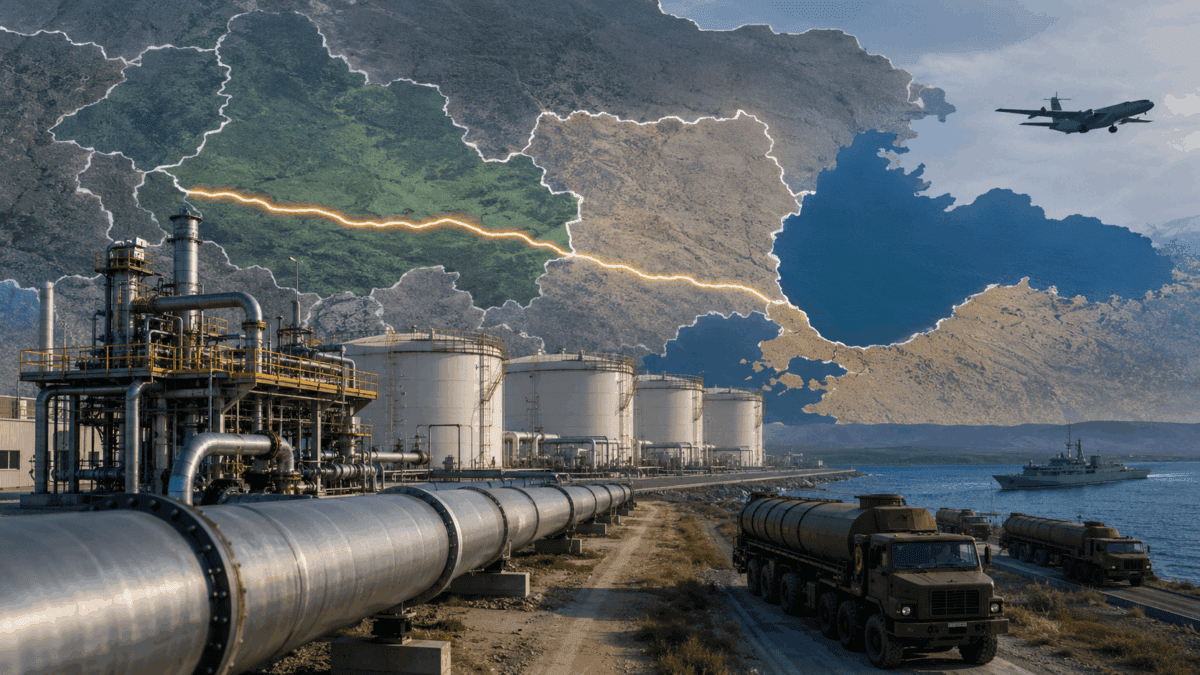
Europe has spent the past two years talking about tanks, air defense and ammunition. Turkey’s new proposal points to a quieter but equally critical problem for NATO: who keeps the war machine fueled if a crisis reaches the alliance’s eastern flank?
Turkey has proposed building a $1.2 billion military fuel pipeline from Turkey to Romania via Bulgaria, according to Bloomberg. The project would supply NATO allies in Eastern Europe and comes as Ankara prepares to host the alliance’s summit in July.
The offer turns fuel logistics into a strategic issue. It also gives Turkey a chance to present itself not only as a military actor inside NATO, but as an infrastructure power linking the Black Sea, the Balkans and the alliance’s southeastern flank.
NATO’s weak point is not only ammunition
NATO’s current fuel infrastructure was designed for a different Europe. The alliance’s pipeline system is about 10,000 kilometers long, runs through 12 NATO countries and has storage capacity of 4.1 million cubic meters, according to NATO. But its central network was built during the Cold War, when the alliance’s main logistical assumptions were focused farther west.
That geography is now outdated. Russia’s war in Ukraine has shifted NATO’s operational center of gravity eastward. Romania, Poland, the Baltic states and Finland have become more important to deterrence planning. But fuel infrastructure has not moved at the same speed.
Lieutenant General Kai Rohrschneider, head of NATO’s Allied Joint Support and Enabling Command, told Reuters in March that the alliance should extend its Cold War-era fuel pipeline network hundreds of kilometers eastward, including toward Romania. He described fuel and ammunition as two of NATO’s largest supply challenges in a possible conflict with Russia.
This is the core of the story. NATO can raise defense budgets, buy aircraft and increase ammunition production. But if fuel cannot be moved quickly and securely, military readiness becomes harder to sustain.
Turkey sees a corridor opening
Ankara’s proposed route matters because it offers a southern alternative into NATO’s eastern flank. A Turkey-Bulgaria-Romania pipeline would strengthen military supply access around the Black Sea region, where NATO’s exposure has increased since the war in Ukraine.
For Turkey, the proposal creates leverage. It places the country at the center of a practical defense problem that NATO cannot ignore. Ankara has often been treated as a complicated ally because of its relations with Russia, disputes with other NATO members and independent regional policy. This project gives Turkey a different argument: it can provide critical infrastructure for alliance readiness.
The price also matters. Reuters has reported that a broader NATO pipeline expansion could cost around €21 billion and take 20 to 25 years to complete. Against that scale, Turkey’s $1.2 billion proposal can be framed as a cheaper and more focused regional solution, although financing, ownership and operational control remain unresolved.
Defense spending is moving into infrastructure
The proposal reflects a wider change in Europe’s security economy. Defense spending is no longer only about weapons platforms. It is moving into pipelines, railways, ports, storage sites, roads and energy systems.
That shift has direct economic consequences. Governments will need to decide whether NATO common funding, national budgets or mixed financing models will pay for new logistics infrastructure. Construction firms, pipeline operators, fuel suppliers and defense contractors could all become part of a wider military mobility market.
Poland’s own plan to connect to NATO’s pipeline network shows the scale of this trend. Reuters reported in 2025 that Warsaw expected its link to cost 20 billion zlotys, or about $5.5 billion. That underlines how expensive eastern fuel connectivity could become if NATO moves from discussion to implementation.
Turkey’s proposal should be read in that context. It is not just a project for moving fuel. It is a bid for position in the next phase of NATO infrastructure spending.
The political test comes next
The project still faces major questions. NATO members would need to agree on funding, technical standards and command arrangements. Bulgaria and Romania would become key transit states in a sensitive military supply network. Turkey would also gain a stronger logistical role at a time when some allies remain cautious about Ankara’s wider foreign policy.
That does not make the proposal impossible. It makes it political.
For NATO, the issue is practical: the eastern flank needs secure fuel supply routes. For Turkey, the opportunity is strategic: a pipeline can turn geography into bargaining power. For Europe, the lesson is broader. The next security bottleneck may not be a missing weapons system. It may be the fuel needed to keep those systems operating.