
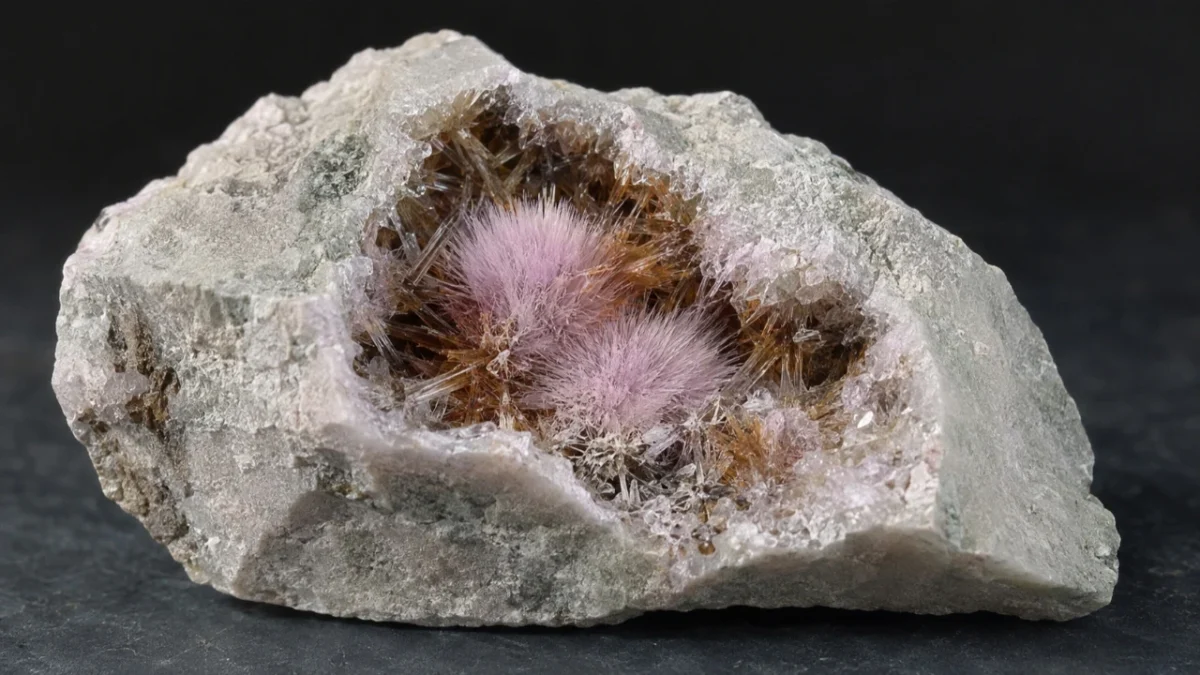
Russian scientists have identified an unusual mineral specimen in the Khibiny Mountains of the Kola Peninsula, where a rare combination of elements has formed one of the most complex crystal structures yet studied.
The mineral, known as Kola ashcroftine, was found at the Kirovsky mine in Russia’s Murmansk region. The research involved scientists from the Kola Science Centre of the Russian Academy of Sciences, St. Petersburg State University and the A.E. Fersman Mineralogical Museum.
Kola ashcroftine contains yttrium, silicon, potassium and sodium, along with calcium, manganese, fluorine and several rare-earth elements. Researchers have described the specimen as a “chemical archive of the Earth’s crust” because so many elements are preserved within a single crystal structure.
A crystal built from natural nanotubes
The most striking feature of the mineral is not simply its chemical composition, but the way its atoms are arranged.
Researchers found that silicon and oxygen form extremely small tube-like structures inside the crystal. These natural silicate nanotubes are only around two nanometres wide and help make Kola ashcroftine one of the most structurally complex minerals examined to date.
The specimen differs chemically from ashcroftine previously identified in Greenland, Canada and Italy. Further comparative research will determine whether it should be formally classified as a separate mineral species or as a distinct variety within the existing ashcroftine group.
Either way, the discovery offers scientists a rare opportunity to study how complex structures can form naturally under geological conditions.
High value, but not a new gold mine
The discovery has also attracted attention because of claims about its market value.
According to estimates reported by Russia’s Ministry of Science and Higher Education, thin ashcroftine coatings on rock specimens may sell for around $145 per millimetre in the collectors’ market.
That figure does not mean the mineral is commercially more valuable than gold on an industrial scale. Gold is traded by weight, while rare mineral specimens are priced according to their size, appearance, condition and scarcity.
Kola ashcroftine is therefore unlikely to become a new mining commodity. Its immediate economic value lies mainly in the specialist collector market and in its potential scientific applications.
The mineral may also interest materials researchers. Its naturally formed nanotube structure could provide a model for developing porous materials used in filtration, chemical processing or other advanced technologies. Any practical application, however, would require years of additional research.
Why the Kola Peninsula matters
The Khibiny Mountains are among the world’s most mineral-rich geological regions. The area contains major deposits of apatite and nepheline and is known for producing rare minerals with unusually complex chemical compositions.
Its geological history created conditions in which elements that rarely occur together could become locked into the same crystal structures.
The discovery of Kola ashcroftine shows why the region continues to attract mineralogists. Beyond its reported price, the mineral’s real importance lies in the information preserved within its crystal—a microscopic record of how rare elements moved, combined and crystallised deep within the Earth.