
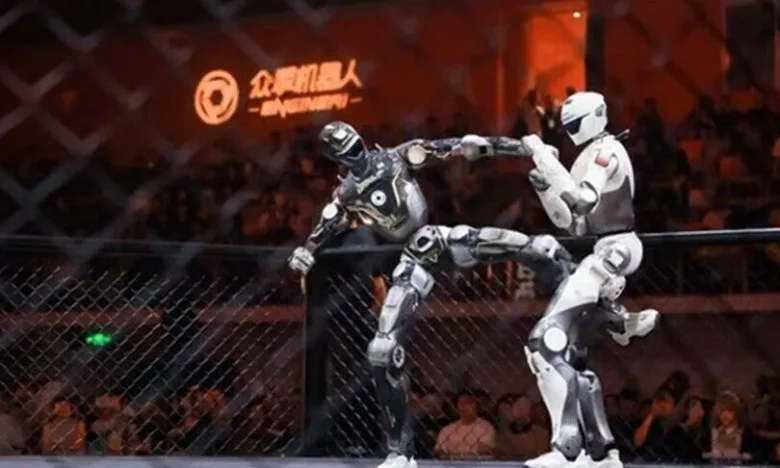
A full-size humanoid robot continued fighting after a powerful kick knocked its head from its body during a combat event in Shenzhen, China.
The robot, named Matador, completed the five-round match despite losing its head unit and ultimately defeated its opponent, White Eagle, by a score of 3–2.
The unusual bout took place on July 16, 2026, during the opening event of the Ultimate Robot Knock-out Legend, or URKL, a new robot combat league launched by Chinese robotics company EngineAI.
A kick sent Matador’s head flying
Matador and White Eagle, both versions of EngineAI’s T800 humanoid robot, exchanged punches, kicks, spinning attacks and defensive movements inside the ring.
The defining moment came when White Eagle landed a direct kick to Matador’s head. The impact separated the head unit from the robot’s body and sent it across the floor.
The damage did not immediately end the fight.
Matador continued moving and completed the remaining action, even though the cameras and other sensors housed in its head were no longer available. After five rounds, judges awarded Matador a 3–2 victory.
The match attracted attention online not simply because of the detached head, but because the robot remained operational after losing one of its most visibly important components.
How autonomous were the fighting robots?
EngineAI said the robots used real-time visual feedback and autonomous decision-making systems during combat.
However, the company has not released enough technical information to establish how much direct operator input was involved in the opening match. It is therefore safer to describe the robots as using AI-assisted control rather than presenting them as completely independent fighters.
The competition evaluates more than physical strength. Effective strikes, balance, defensive movement and the ability to remain operational after taking damage are also part of the performance.
Because teams use the same basic robot platform, much of the difference between competitors is expected to come from software, movement algorithms, tactical programming and permitted mechanical modifications.
Organizers said more than 200 teams applied to take part in the league, with 32 selected for the official competition. The Shenzhen event featured the opening bout rather than the entire group of teams competing at once.
Full-size humanoid robots enter the ring
EngineAI’s T800 stands approximately 1.73 meters tall and weighs between 75 and 85 kilograms, depending on its configuration.
Some versions offer up to 29 degrees of freedom in the body, allowing the robot to turn, kick, shift its weight and recover its balance. The platform also uses high-torque joints and environmental sensing systems designed to support rapid movements.
Combat places these systems under stresses that are difficult to reproduce in a controlled laboratory demonstration.
A robot performing a rehearsed movement on a flat surface faces predictable conditions. In a fight, it must respond to sudden impacts, unstable footing, damaged components and an opponent whose movements cannot be fully anticipated.
Matador’s damaged head therefore became an unexpected durability test. Its ability to continue showed that the robot’s core control hardware was not entirely dependent on the head unit.
At the same time, the incident exposed a clear weakness. Head-mounted cameras and sensors remain vulnerable to direct impacts, and losing them can severely reduce a robot’s ability to perceive its surroundings.
Robot fighting becomes a testing ground
Humanoid robot combat is designed partly as entertainment, but the ring also functions as a demanding engineering test.
The matches can reveal weaknesses in joint construction, impact resistance, energy management and balance-control software. They can also show whether a robot can continue functioning when individual components are damaged or disconnected.
These capabilities matter beyond sport.
Humanoid robots intended for factories, warehouses, emergency response or hazardous environments may also need to remain stable after collisions, falls or unexpected mechanical failures. Combat events provide an exaggerated version of those conditions, but the underlying engineering problems are similar.
Organizers want to build a commercial league
EngineAI founder and CEO Zhao Tongyang said the tournament was created to accelerate research and commercialization while developing a globally recognized humanoid robot combat brand.
Organizers describe URKL as the first global commercial free-fighting league for full-size humanoid robots.
That wording is important because robot fighting itself is not entirely new. Smaller Unitree G1 humanoid robots took part in a televised combat event in China in May 2025.
URKL is attempting something broader: an ongoing international competition built around full-size humanoid platforms rather than a one-off technology demonstration.
According to the league’s current schedule, further matches will be held before a global final planned for late 2026 or early 2027.