
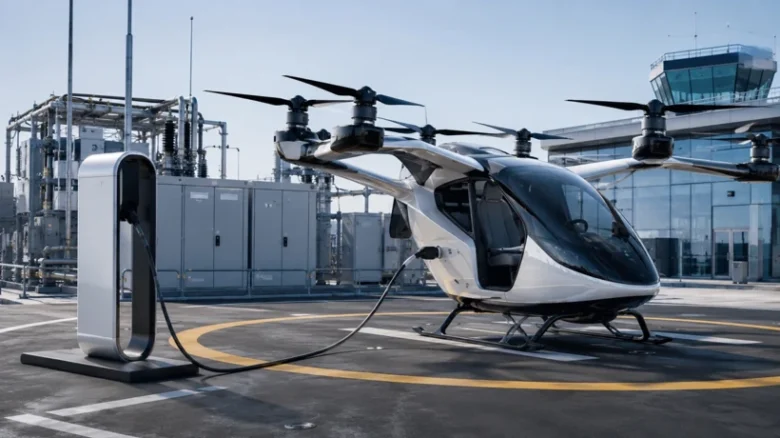
Flying taxis have spent years proving that electric aircraft can safely carry passengers above crowded cities. Now the industry faces another problem: how to recharge large fleets between flights.
Eve Air Mobility and Hitachi Energy have formed a partnership to develop eVTOL charging infrastructure for future vertiports. The companies will study how high-powered chargers, electricity networks and energy-storage systems could support commercial electric aircraft operations.
The agreement is Eve’s first partnership dedicated specifically to charging infrastructure.
Flying taxis will need more than landing pads
Electric vertical takeoff and landing aircraft, or eVTOLs, are designed for short journeys within cities and surrounding metropolitan areas. Their commercial success, however, will depend partly on how quickly they can return to the air after landing.
Unlike private electric cars, flying taxis cannot remain connected to chargers for several hours. Operators will need aircraft to complete multiple journeys each day, leaving relatively short periods for recharging, passenger boarding and safety checks.
That will place unusual demands on vertiports. Several aircraft could require large amounts of electricity at the same time, especially during busy travel periods.
Hitachi Energy and Eve will examine the power capacity, grid connections and charging systems needed to support those operations. The companies have not yet disclosed the charging speed, electrical capacity or turnaround time they expect future vertiports to achieve.
Electric bus charging technology could be adapted
Hitachi Energy plans to evaluate whether its Grid-eMotion charging platform can be adapted for electric aircraft.
The technology was developed for commercial electric vehicle fleets, including buses that return regularly to depots for rapid charging. A similar system could manage the power supplied to several aircraft while balancing demand across a vertiport.
The partnership will also investigate the reuse of retired aircraft batteries.
A battery may eventually become unsuitable for aviation because it can no longer meet strict weight, range or performance requirements. It could still retain enough capacity for stationary storage, allowing vertiports to store electricity and reduce pressure on the grid during intensive charging periods.
The companies have not announced whether such second-life battery systems will be tested at a specific airport or city.
Eve targets commercial operations in 2028
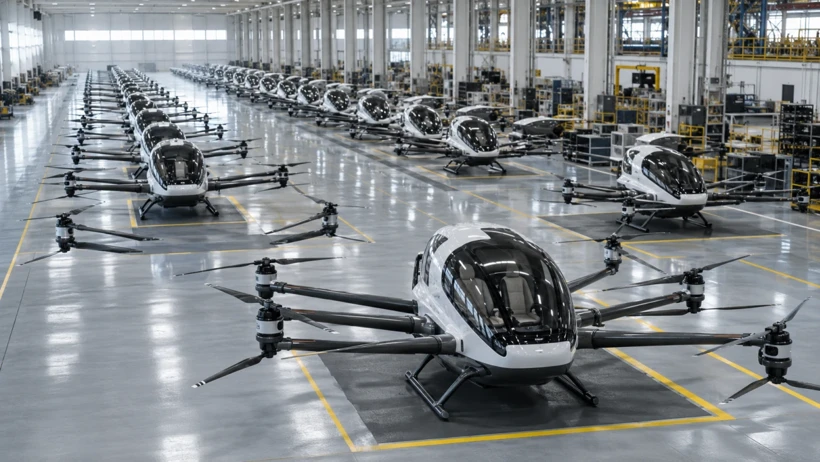
Eve is developing a lift-and-cruise aircraft with eight rotors for vertical takeoff and landing, fixed wings for forward flight and separate propellers for cruise.
The planned commercial model will initially carry four passengers and one pilot. Eve is targeting a range of about 100 kilometres, placing the aircraft in the short-distance urban mobility market.
Its full-scale engineering prototype completed its first flight in December 2025. By April 2026, Eve said the aircraft had passed 50 test flights and completed the hover and low-speed stage of the programme.
The next major step involves testing the transition from rotor-supported flight to wing-supported forward flight. Eve is targeting certification and commercial entry into service in 2028, although that timetable remains dependent on testing and regulatory approval.
The company says its global commercial pipeline covers approximately 2,700 aircraft. Most remain covered by letters of intent, while 100 aircraft have been converted into binding agreements.
The figure therefore represents potential demand rather than 2,700 completed sales.
Charging infrastructure joins the eVTOL race
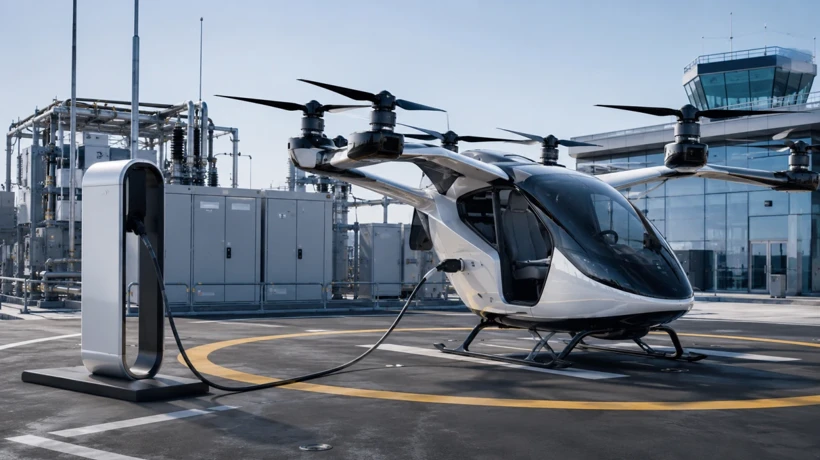
Aircraft certification has dominated the flying taxi industry, but commercial operations will also require vertiports capable of supplying large amounts of electricity safely and consistently.
Operators must know how many aircraft a site can charge, how long each charging cycle will take and whether the local grid can handle repeated high-power demand.
Certification alone will not put flying taxis into service. Cities and operators will also need the electrical infrastructure to keep them in the air.