
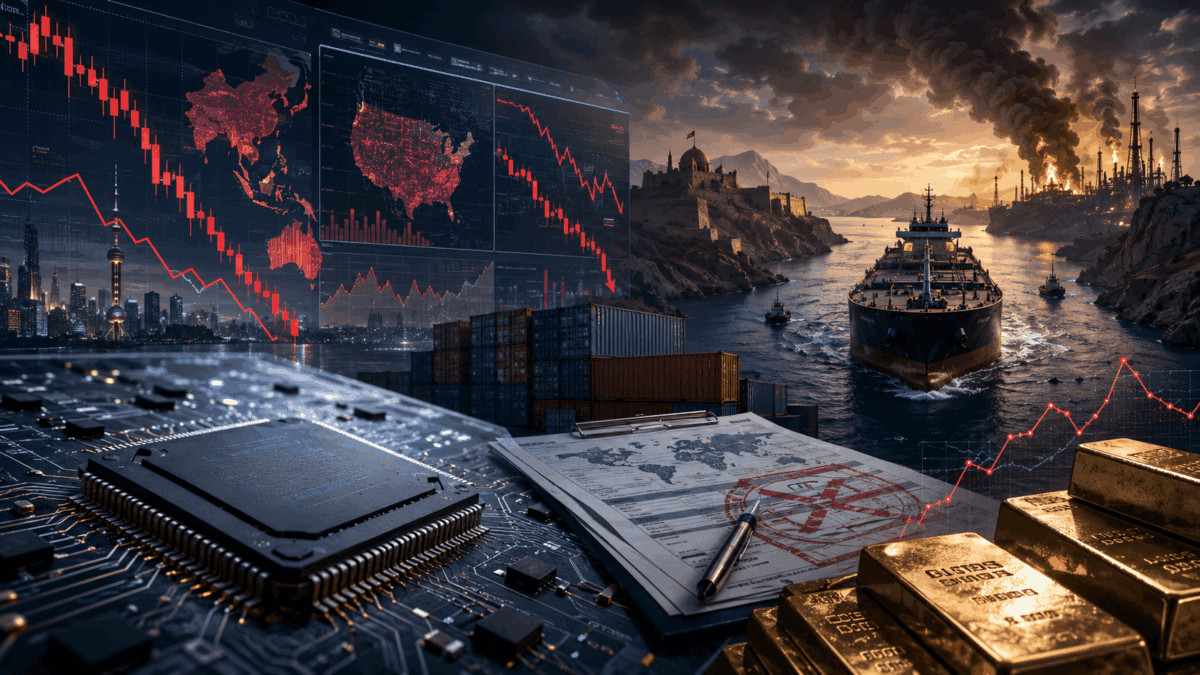
A sharp semiconductor sell-off spread from Asia to Wall Street on Friday as investors struggled to price artificial intelligence spending, changing US trade policy and an expanding conflict with Iran at the same time.
The decline began in technology and chip shares but quickly developed into a broader retreat. Strong corporate earnings were not enough to offset concerns over high valuations, rising energy prices and political decisions capable of changing the market outlook within hours.
Chip shares lead the decline
Taiwan’s benchmark TWII index fell 6.5 percent, while Japan’s Nikkei 225 lost about 4 percent. South Korean markets were closed for a public holiday.
The sell-off also reached mainland China. The Shanghai Composite declined 3.05 percent, and the Shenzhen Component dropped 5.4 percent as technology and artificial intelligence shares came under pressure.
Taiwan Semiconductor Manufacturing Company fell 7.3 percent despite reporting a 77 percent increase in second-quarter net profit to a record T$706.6 billion, equivalent to almost $22 billion.
TSMC’s results confirmed that demand for advanced artificial intelligence processors remains strong. The company also raised its planned capital expenditure. Yet investors focused less on current earnings and more on whether the growing cost of chip factories, data centres and AI infrastructure will produce sufficient returns.
That shift in sentiment has changed the way strong results are received. A company can report record profits and still lose market value when investors believe future growth is already reflected in its share price.
AI spending faces closer scrutiny
The decline continued in the United States. The S&P 500 fell 1.01 percent to 7,457.69, the Dow Jones Industrial Average dropped 0.77 percent to 52,146.42, and the Nasdaq Composite lost 1.4 percent to close at 25,520.24.
Applied Materials fell 5.6 percent, Nvidia declined 2.2 percent, and other semiconductor and hardware companies also moved lower. The Philadelphia Semiconductor Index ended the session 20.2 percent below its June 22 record, placing it in bear-market territory.
The release of Kimi K3, a new open-weight AI model developed by Chinese company Moonshot AI, added to concerns about the cost of artificial intelligence development.
The model was not the sole reason for the sell-off. It arrived as investors were already questioning whether increasingly capable AI systems could be built with fewer chips and less computing power than US technology companies currently plan to use.
The central question is no longer whether artificial intelligence will expand. Investors are asking how much infrastructure is actually needed and which companies will earn enough from that expansion to justify today’s valuations.
Trump tariffs keep businesses guessing
Technology valuations are only one source of uncertainty.
Since Donald Trump returned to the White House in January 2025, tariffs have become a central part of US economic policy. New duties, temporary measures, exemptions and legal challenges have repeatedly altered the trade environment facing businesses.
The average effective US tariff rate rose sharply during 2025 before later changes brought it down. Yale’s Budget Lab estimated the rate at 11.8 percent in April 2026, still far above the level recorded before Trump returned to office.
For companies, the difficulty is not only the tariff rate itself. Manufacturers and retailers must make long-term decisions while import costs, supplier arrangements and access to foreign markets remain exposed to sudden political change.
The same uncertainty affects investors. A tariff announcement can raise expectations for domestic production while also increasing fears of higher costs, slower trade and renewed inflation.
Markets are therefore pricing political statements alongside earnings, employment figures and central-bank policy.
Iran conflict pushes oil higher
The war with Iran has added another source of instability.
US strikes on infrastructure inside Iran, Iranian attacks elsewhere in the Gulf and continued disruption around the Strait of Hormuz raised concerns over energy supplies.
Brent crude rose 4.6 percent on Friday to settle at $88.10 a barrel, up from roughly $76 a week earlier. Energy was the only major S&P 500 sector to end the session higher.
The rise in oil prices has complicated the outlook for inflation and interest rates. More expensive energy can increase transport and production costs, making it harder for central banks to reduce borrowing costs.
Gold rose by about 1 percent on Friday to $4,011.29 an ounce but still ended the week approximately 2.6 percent lower.
The conflicting movement reflected the market’s uncertainty. War increased demand for defensive assets, while the rise in oil prices strengthened expectations that interest rates could remain high. Higher rates generally reduce the appeal of gold because the metal does not provide interest income.
Markets cannot settle on one story
Friday’s decline was triggered by semiconductor shares, but the pressure extends beyond the technology sector.
Artificial intelligence spending continues to support growth, yet the scale of investment is raising questions about profitability. Tariffs may protect some domestic industries, but they also increase costs and weaken business visibility. The Iran conflict supports oil prices while threatening growth and adding to inflation.
These forces point in different directions. Strong earnings suggest continued expansion, while high valuations leave little room for disappointment. Higher oil prices support energy companies but raise costs across the wider economy.
Markets have not stopped responding to economic fundamentals. Those fundamentals are now repeatedly interrupted by tariff announcements, military developments and political statements.
The immediate trigger was a chip-sector sell-off. The larger problem is that global markets no longer have a stable narrative around which prices can form.