
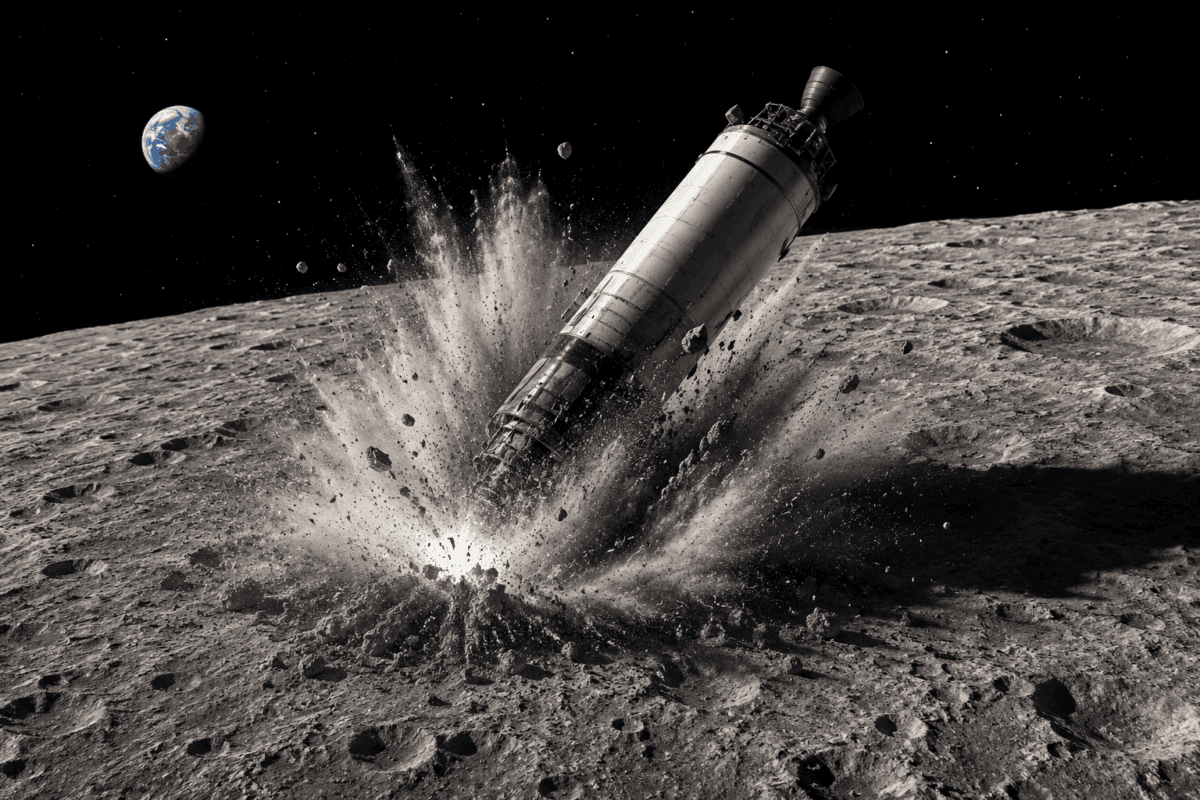
A spent SpaceX Falcon 9 upper stage is expected to strike the Moon on August 5, 2026, at approximately 06:34–06:35 UTC. The collision will occur near Einstein Crater, on sunlit terrain close to the lunar limb, at a speed of about 2.43 kilometers per second—roughly 8,700 kilometers per hour.
The impact poses no threat to Earth. Its scientific value lies elsewhere: researchers know what the object is, have followed its orbit and can prepare telescopes and lunar spacecraft before it reaches the surface.
Natural meteoroids normally hit the Moon without warning. This time, astronomers have an opportunity to compare observations with predictions made before a large, hollow, human-made object strikes.
Two scientific preprints published in July outline how the event could be observed and what may happen when the rocket stage reaches the lunar surface. Both studies stress that the brightness, crater shape and movement of the debris remain uncertain.
Left Behind After Two Lunar Missions
The object, catalogued as 2025-010D, has remained in a highly elliptical orbit around Earth since January 15, 2025.
It was the upper stage used to launch Firefly Aerospace’s Blue Ghost Mission 1 and ispace’s RESILIENCE lander toward the Moon. Blue Ghost landed successfully on March 2, 2025, and completed its planned surface mission. Contact with RESILIENCE was lost shortly before its attempted landing on June 5.
The Falcon 9 stage stayed in Earth orbit after releasing the spacecraft. According to orbital calculations published by Project Pluto, it now completes one orbit in about 26 days, travelling between approximately 220,000 and 510,000 kilometers from Earth.
That wide orbit crosses the Moon’s path. On August 5, the Moon and the rocket stage are expected to reach the intersection at the same time.
The Dust Plume Could Rise 100 Kilometers
A simulation led by William Jo of the University of Texas at Austin models the rocket stage with a mass of approximately 3,900 kilograms.
The study predicts that the main curtain of dust and broken lunar material could rise between 15 and 20 kilometers above the surface. A narrower central spike may reach an altitude of 75 to 100 kilometers, while debris could spread laterally for about 183 kilometers from the impact point.
These figures are predictions rather than measurements. Rocket stages behave differently from natural asteroids because they are largely hollow and contain components distributed unevenly along their length. Their orientation at the moment of impact could also affect the shape of the crater and the direction of the debris.
Published estimates for the resulting crater range from roughly 17 to 27 meters across. The difference reflects the assumptions used about the stage’s mass, structure and interaction with the lunar surface. Bill Gray of Project Pluto estimates a crater close to 17 meters wide, while planetary scientist Benjamin Fernando has suggested it may reach about 27 meters across and five meters deep.
The Impact Flash May Be Difficult to See
Despite the energy involved, the initial flash may be faint.
Natural meteoroids often strike the Moon at tens of kilometers per second. The Falcon 9 stage will be moving much more slowly, meaning that a smaller share of its energy may be converted into visible light. The impact will also take place on the Moon’s illuminated surface, making a brief flash harder to distinguish.
The debris plume may offer a better target. Because the impact point lies close to the lunar edge as seen from Earth, material rising above the surface could appear against the darkness of space.
Professional observatories and experienced amateur astronomers have been encouraged to record the event. Sensitive instruments, precise timing and favorable weather will be necessary; it is not expected to be visible to the unaided eye.
NASA’s Lunar Reconnaissance Orbiter and South Korea’s Danuri orbiter are also expected to collect images of the area before and after the collision. Those observations could reveal the crater’s position, dimensions and the distribution of freshly excavated material.
An Accidental Experiment—and a Space Debris Warning
Artificial objects have struck the Moon before. Apollo-era rocket stages were deliberately sent into the surface to generate seismic signals, while NASA’s LCROSS mission created a controlled impact near the lunar south pole in 2009 to search for water ice.
The approaching Falcon 9 collision is different because it was not planned as a scientific experiment. Researchers are taking advantage of an event produced by a discarded rocket stage whose orbit gradually carried it toward the Moon.
For deep-space launches, upper stages can sometimes be directed into solar orbits that take them away from the Earth-Moon system. Whether that is possible depends on the mission’s trajectory, remaining fuel and disposal planning.
The August 5 collision is unlikely to damage anything beyond an empty patch of lunar ground. But as governments and private companies send more spacecraft toward the Moon, abandoned hardware will become harder to dismiss as an occasional curiosity.
The impact itself will be over in seconds. The more useful evidence may arrive later, when orbiters photograph the new crater and scientists compare the real result with models completed before the crater existed.