
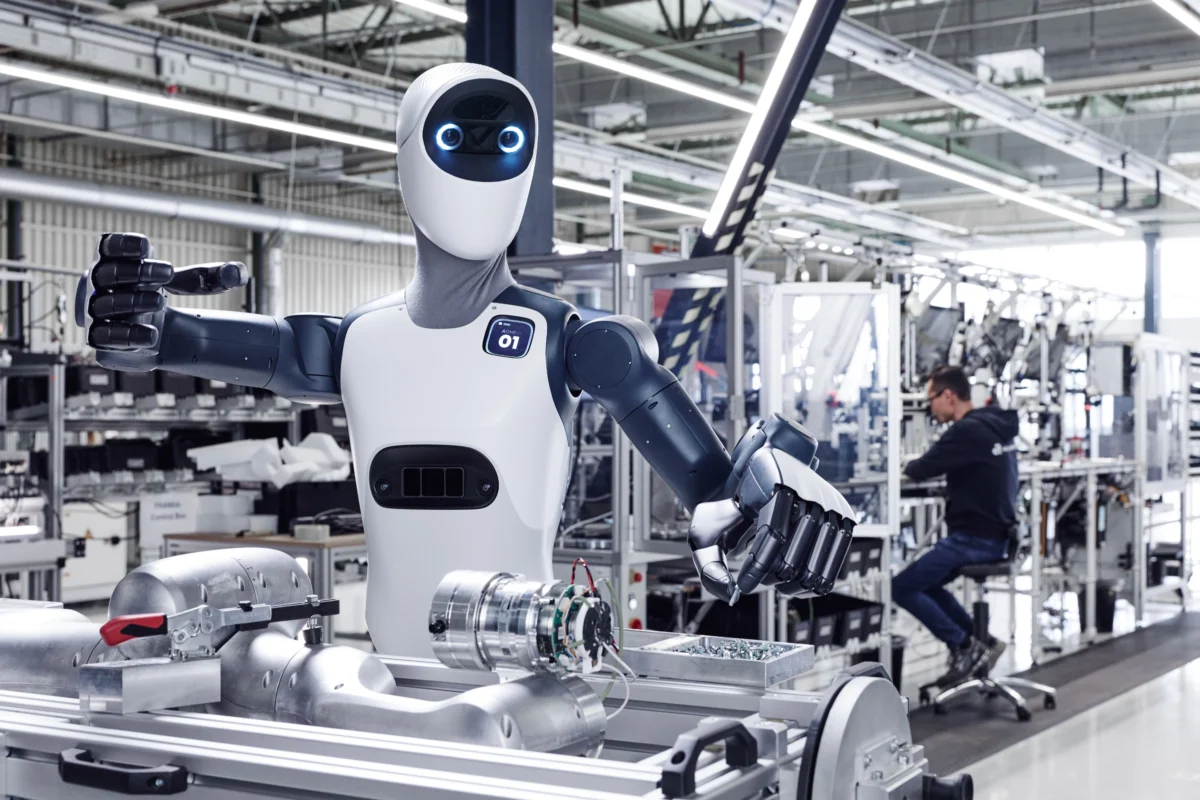
German robotics company Agile Robots expects its annual revenue to reach €600 million in 2026, twice the €300 million recorded last year, as demand grows for industrial automation systems that combine robotics with artificial intelligence.
The forecast is backed by customer contracts that have already been signed, founder and CEO Zhaopeng Chen told The Wall Street Journal. Chen expects the Munich-based company to become profitable within two to three years.
The figures are striking, but they do not yet represent a commercial breakthrough for humanoid robots. Agile’s humanoid machines remain in pilot projects. Most of the company’s current expansion is tied to factory automation, engineering services and the integration of robotic systems into existing production lines.
Growth built on factory automation
Founded in 2018 by researchers with backgrounds at the German Aerospace Center, Agile Robots develops robotic arms, mobile platforms, dexterous hands and the software used to coordinate them.
Its first industrial humanoid, Agile ONE, was introduced in November 2025. The robot is designed to move materials, operate machinery, use tools and handle small components. The company plans to manufacture it at its own facility in Bavaria.
Agile ONE, however, is only one part of a larger production system. Agile also sells force-sensitive robotic arms, autonomous mobile robots and automated guided vehicles. These machines are connected through AgileCore, the company’s software platform.
For manufacturers, the commercial value lies less in owning a human-shaped machine than in keeping an entire production line operating efficiently. A robot that performs well in a laboratory may still fail when it encounters dust, vibration, uneven surfaces or machinery built decades earlier.
Chen recalled one deployment at a crankshaft factory in India where an uneven floor disrupted the robotic system. Instead of asking the manufacturer to rebuild the production area, Agile redesigned the system to work under the conditions already present at the site.
That type of engineering work is less visible than a humanoid demonstration, but it helps explain why Agile has been able to move beyond small-scale trials and secure paying industrial customers.
Acquisitions bring customers and experience
Agile Robots has acquired more than a dozen businesses since it was founded. These deals have provided more than additional revenue: they have brought experienced engineers, manufacturing relationships and access to factories where new robotic systems can be tested and deployed.
In April 2026, the company completed its acquisition of assets belonging to thyssenkrupp Automation Engineering in Europe and North America. The acquired operations now trade as Krause Automation.
The deal combined Agile’s AI and robotics technology with more than 75 years of experience in production engineering and factory integration. It also expanded the group’s presence in automotive manufacturing while opening opportunities in consumer electronics, medical technology and logistics.
Chen expects acquired companies to generate around 10% to 15% of Agile’s new contracts in 2026. Their greater value may be the trust they already hold with major manufacturers, where suppliers must demonstrate that equipment can operate reliably for years rather than for the length of a technology demonstration.
Real factory data feeds its AI strategy
Agile calls its combination of robotics, artificial intelligence and industrial engineering “physical AI.” The goal is to develop machines that can perceive their surroundings, adjust to changing conditions and learn new tasks without being fully reprogrammed each time.
The company has entered a research partnership with Google DeepMind to integrate Gemini Robotics foundation models with Agile’s hardware. The initial work will focus on industrial tasks where reliability and adaptability are more important than the ability to perform a wide variety of loosely defined actions.
Data collected during real deployments will be used to improve the models. Better models could then allow the machines to complete more tasks, creating a cycle between factory use, data collection and robot development.
Agile also plans to train robotics models using the Industrial AI Cloud developed by Deutsche Telekom and Nvidia. The company said in late 2025 that it employed more than 1,000 robotics and AI specialists and had installed more than 20,000 robotic solutions worldwide. Those deployment and workforce figures come from Agile itself and have not been independently audited in its announcements.
Humanoid robots remain the longer-term wager
Agile has raised approximately $1.5 billion from investors led by SoftBank, according to Chen. Part of that funding is supporting research into humanoid robots and other systems that could eventually operate outside factories.
Chen believes humanoids could become a consumer product category positioned between smartphones and automobiles. He predicted that such machines could become a normal sight in public within 10 to 15 years.
For now, that market remains speculative. Agile’s €600 million revenue target rests on work that is already less futuristic: installing automation systems, adapting them to imperfect factories and persuading manufacturers that the technology is reliable enough to become part of everyday production.