
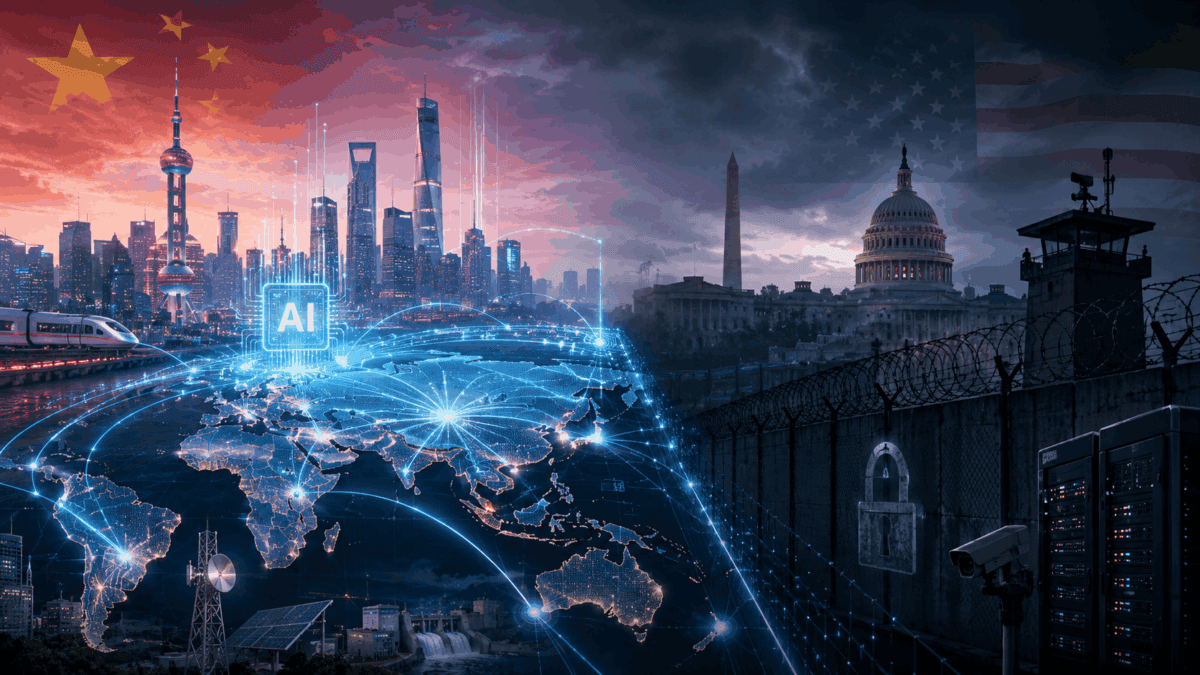
China’s AI strategy is no longer limited to building competitive models or challenging American technology companies. Beijing is now trying to turn artificial intelligence into the foundation of a new international network.
The creation of the World Artificial Intelligence Cooperation Organization, or WAICO, with 29 founding countries is the clearest sign yet of that ambition.
While the United States is attempting to preserve its technological lead through export controls, restrictions and national-security alliances, China is taking a different route. It is offering developing countries access to AI models, digital infrastructure, technical training and institutional cooperation.
Washington is trying to protect its advantage. Beijing is trying to make itself indispensable.
WAICO, which will be headquartered in Shanghai, includes Russia and several developing economies, including Kazakhstan, Indonesia, Pakistan and Laos. China has not disclosed the full membership list.
The organization officially aims to promote the safe, beneficial and equitable development of artificial intelligence. But its strategic value is much greater. WAICO could provide Beijing with a permanent institution through which it can shape global AI standards, expand the use of Chinese technology and build deeper ties with countries across the Global South.
Washington restricts while Beijing recruits
The United States increasingly treats artificial intelligence as a strategic asset that must be protected from competitors.
Washington has restricted China’s access to advanced semiconductors, chipmaking equipment and high-performance computing systems. These measures are intended to slow Chinese technological development while preserving the leadership of American companies.
The strategy follows a familiar model of US power: define a security threat, restrict access to critical resources and pressure allies to adopt the same position.
China is pursuing many of the same goals, including technological influence and long-term economic advantage. But it is presenting them through the language of access, cooperation and development.
Rather than demanding that countries choose between rival security blocs, Beijing is offering AI models, data infrastructure, research partnerships and engineering training.
That offer is especially attractive to governments that cannot afford the most advanced American systems or face political and commercial restrictions on accessing them.
China has recognized that the next phase of global competition will not be decided only by which country produces the most powerful AI model. It will also be decided by which country’s technology is adopted by the largest number of governments, universities and businesses.
Open-source AI is becoming a diplomatic weapon
Open-source artificial intelligence has become one of China’s most effective tools in this competition.
Many leading American AI systems remain proprietary, expensive and dependent on infrastructure controlled by a small number of US corporations. Chinese models are increasingly marketed as more adaptable and accessible, particularly for countries with limited computing capacity.
For many governments in Asia, Africa, Latin America and the Middle East, the choice may not be between equally available American and Chinese systems.
The real choice may be between expensive technology with restrictions and a cheaper alternative supported by infrastructure, training and political cooperation.
This does not make China’s offer charitable.
An AI model may be open source, but the ecosystem required to operate it is not. Artificial intelligence depends on servers, cloud platforms, data centers, energy supplies, engineers and technical standards.
Countries that adopt Chinese AI systems may also become dependent on Chinese hardware, software updates, cloud services and technical expertise.
Over time, that dependence could give Beijing influence over the architecture of another country’s digital economy.
WAICO could help institutionalize these relationships. Instead of negotiating separate agreements with individual governments, China may now be able to develop shared standards, training programs and infrastructure projects under the umbrella of an international organization.
Global power no longer requires occupation
In the past, global dominance was measured through territory, military bases, naval strength and control of trade routes.
Artificial intelligence is changing how influence is built.
A country that supplies another nation’s communication networks, data centers, public-sector software and AI systems can gain significant leverage without controlling its territory.
China has already used infrastructure investment to expand its presence through ports, railways, energy networks and telecommunications systems. AI adds a more powerful layer because it could become embedded in government administration, education, finance, healthcare and security.
The country that provides these systems may also influence the standards used to manage data, regulate algorithms and deploy digital surveillance.
China does not need to conquer countries militarily to shape their decisions. It needs to become a central provider of the technologies on which their economies and institutions rely.
The participation of developing countries in WAICO is therefore important. Many of these nations will become some of the world’s largest digital markets over the coming decades. They also have growing demand for advanced technology but limited access to the capital and infrastructure required to build it independently.
China is entering that gap with a clear proposal: technology, training and infrastructure without the political conditions usually associated with Western alliances.
China’s offer comes with serious risks
Beijing’s language of cooperation and equal access should not be accepted without scrutiny.
Dependence on Chinese AI systems could create risks involving data security, political influence and economic sovereignty. Countries may gain cheaper access to advanced technology while losing control over parts of their digital infrastructure.
China’s domestic use of facial recognition, mass data collection and automated surveillance also raises another concern. Beijing could export not only AI products but also a model of technology-driven governance built around stronger state control.
Governments adopting Chinese systems may therefore be purchasing more than software. They may also be importing technical standards that make surveillance easier and public accountability more difficult.
But these risks do not necessarily weaken China’s strategy.
Beijing does not need to offer a perfect system. It only needs to provide one that is affordable, practical and available when Western alternatives are too expensive or politically restricted.
That is where the United States may be misreading the competition.
Washington still appears focused on preventing rivals from reaching the technological frontier. China is focused on placing its technology in as many countries as possible.
One strategy protects an existing hierarchy. The other builds a new network.
WAICO will not overturn the global AI order immediately. But it shows that China now wants more than successful technology companies and powerful models. It wants to help write the international rules, standards and institutions of artificial intelligence.
The United States is still trying to win the AI race.
China is building the track.