
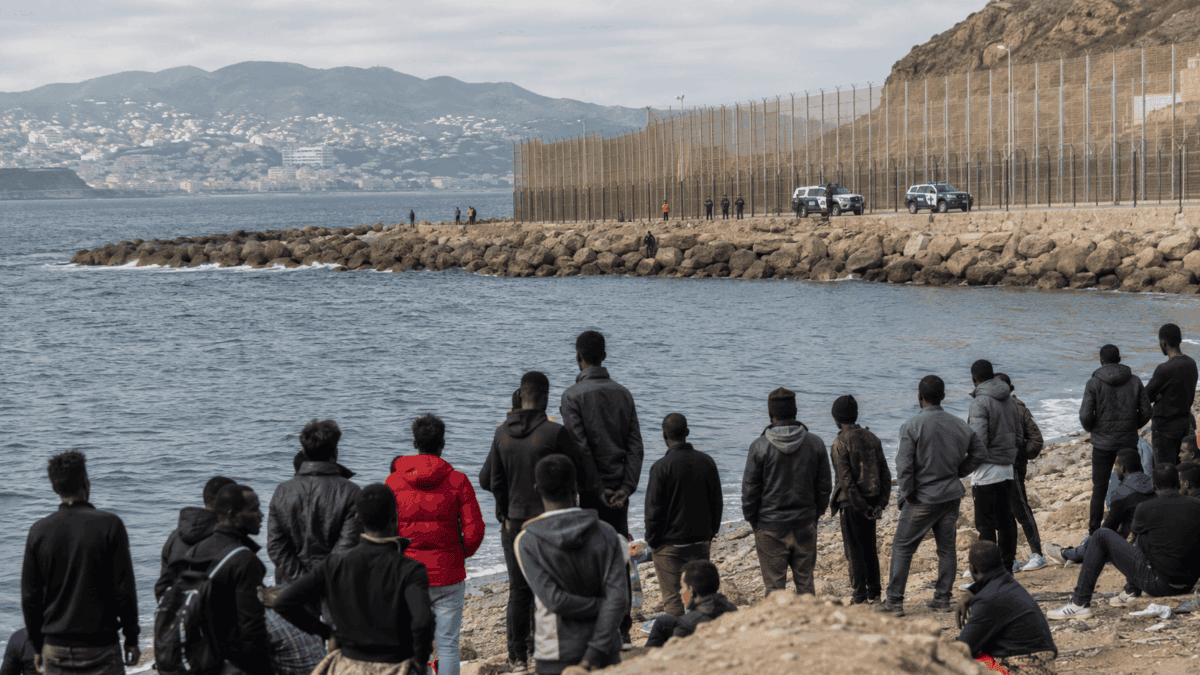
The sudden arrival of tens of thousands of migrants in Ceuta is being treated primarily as a border emergency. Yet the political reaction suggests that the crisis may carry wider consequences for Europe.
Around 50,000 people crossed from Morocco into the Spanish enclave within roughly 24 hours. Spanish authorities deployed military units, while dozens of people died amid drownings, crowd pressure and clashes at the border. Most of those who entered later returned to Morocco, sharply reducing the immediate pressure on Ceuta.
The more significant development came from Italy.
Prime Minister Giorgia Meloni’s government temporarily restored checks on passengers arriving from Spain by air and sea. The measure, initially introduced for one month, focuses on non-EU nationals and does not amount to closing a conventional land border—Italy and Spain do not share one. Its practical impact may therefore be limited.
Politically, however, the decision is difficult to dismiss.
Italy used a migration emergency confined largely to a Spanish territory in North Africa to restrict movement from another Schengen member. France also strengthened controls along its border with Spain. The response demonstrated how rapidly a crisis on Europe’s external frontier can be converted into internal pressure against an individual EU government.
Spain Was Already Under Pressure
The Ceuta crisis did not emerge in a political vacuum.
Relations between Pedro Sánchez’s government and the Trump administration had already deteriorated over NATO spending and the war involving the United States, Israel and Iran.
Madrid refused to allow the jointly operated Rota and Morón bases to be used for attacks against Iran. American military aircraft were subsequently moved out of Spain. Sánchez’s government also resisted Washington’s demand that NATO members commit 5 percent of their economic output to defence and security spending by 2035.
Trump responded by threatening to halt trade with Spain, first in March and again during the July NATO summit. Although implementing a bilateral trade embargo against an individual EU member would face major legal and political obstacles, the threat revealed a more transactional American approach: access to US security and economic relations would increasingly depend on political alignment.
This makes Italy’s response to Ceuta more consequential.
There is no need to argue that Washington engineered the migration surge or directly instructed Rome. That would go beyond the available evidence. The stronger argument is that the crisis entered a political environment already prepared to exploit it.
Italy’s decision placed additional pressure on a Spanish government that had openly challenged Washington on defence, Iran and relations with Israel. At the same time, it strengthened the position of European governments that favour tougher migration controls and closer strategic coordination with Trump.
Fragmentation, Not Immediate Collapse
Ceuta is unlikely to cause the European Union to disintegrate. The more credible risk is gradual fragmentation.
Schengen may formally survive while national border controls become increasingly common. NATO may remain intact while members follow sharply different policies toward Washington. The EU may continue operating as a single market while its governments divide into competing political and security camps.
Economic weakness could intensify that process. The European Commission expects EU growth of only about 1.1 percent in 2026, while high energy costs, defence spending and geopolitical instability continue to constrain national budgets. Europe is not facing economic collapse, but prolonged low growth makes political solidarity harder to maintain.
The Ceuta crisis should therefore be viewed as more than a migration story. It may represent an early test of a new European order—one in which the United States applies pressure selectively, national governments increasingly challenge common EU rules and migration emergencies become instruments in a wider struggle over political alignment.
The question is no longer simply whether Europe will remain united.
It is whether that unity will retain any strategic meaning.