
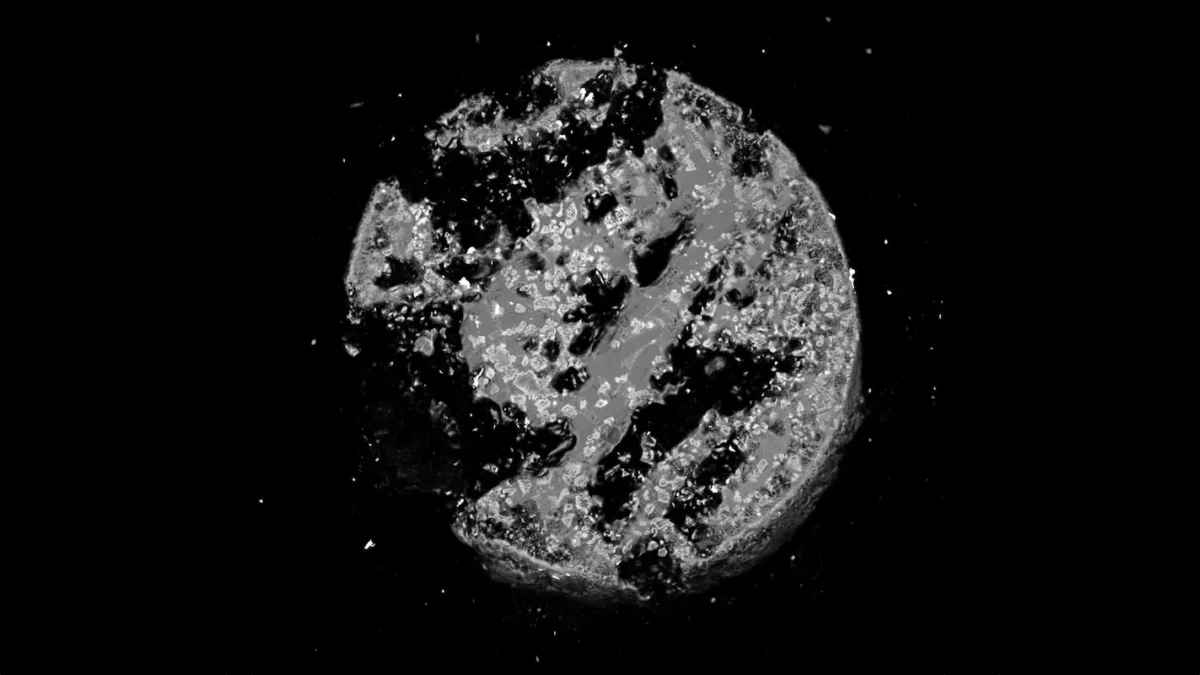
More than 80 years after the atomic bombing of Hiroshima, a microscopic piece of debris has revealed another consequence of the explosion: the creation of a metallic alloy never previously documented by scientists.
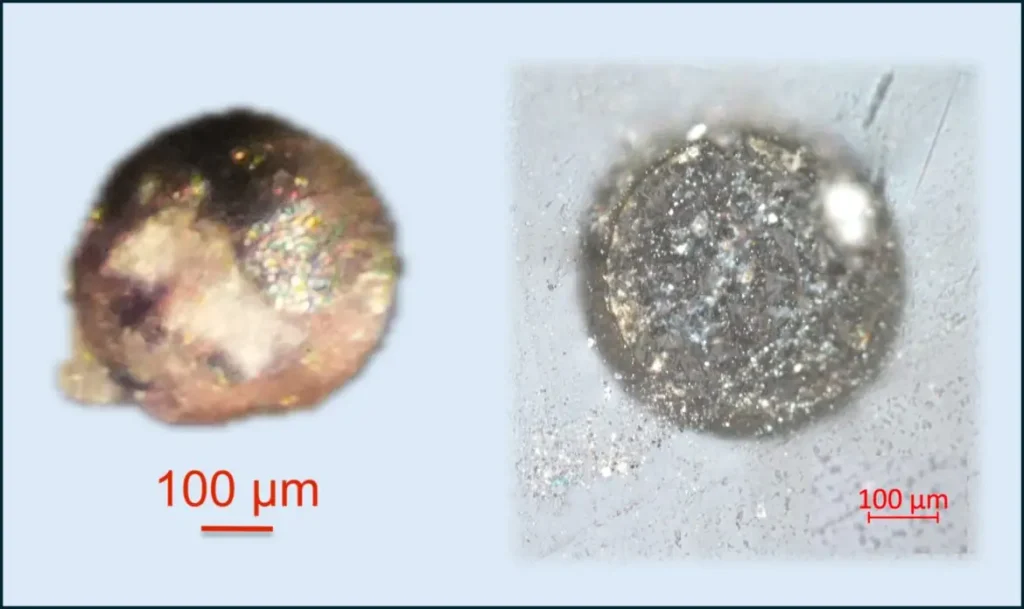
The material was discovered inside a tiny glass particle recovered from the sands of Hiroshima Bay. Known as a hiroshimaite, the particle formed when the atomic fireball melted and vaporized materials from the city on August 6, 1945.
Researchers led by Luca Bindi of the University of Florence found several metal fragments trapped inside the glass. One stood out because of its unusual mixture of elements and highly ordered internal structure.
The discovery was reported in the journal Science Advances.
A City Turned into Vapor—and Glass
The newly identified material is not a new chemical element. It is an unfamiliar alloy created from known elements, including iron, chromium, nickel, manganese, molybdenum, aluminum and silicon.
Scientists believe it formed during the brief and extreme conditions inside the nuclear fireball.
The explosion vaporized a chaotic mixture of steel, aluminum, glass, concrete, soil and other materials from Hiroshima’s urban landscape. As the fireball expanded, some of that vapor condensed and cooled almost instantly.
The sudden cooling appears to have locked the atoms into an arrangement they would not normally adopt in nature or in conventional metal production.
Most alloys are produced under carefully controlled conditions. The Hiroshima material emerged from the opposite: an uncontrolled mixture exposed to extraordinary heat and then frozen into place within moments.
That is what makes the microscopic grain scientifically unusual. Its composition reflects not only the bomb itself, but also the buildings, infrastructure and ground materials consumed by the blast.
A Microscopic Record of August 6, 1945
Hiroshimaites were first recognized in beach sands near the city years after the bombing. Their rounded, glassy forms are thought to have developed as melted material rose into the blast cloud, mixed together and later fell back to the ground.
Some contain traces of concrete, stainless steel, glass and other materials once present in Hiroshima. This has led researchers to describe them as physical archives of the destroyed city.
The newly discovered alloy strengthens that idea. Although the grain is extremely small, its structure preserves evidence of the temperature, chemical mixing and rapid cooling that occurred during the explosion.
Such particles may help scientists better understand what happens to matter during nuclear detonations. They may also assist nuclear forensics, which uses physical debris to reconstruct the origin and conditions of a nuclear event.
The research does not suggest that the Hiroshima bombing should be viewed simply as a materials experiment. The attack destroyed much of the city, and approximately 140,000 people had died from its immediate and subsequent effects by the end of 1945.
Instead, the discovery shows how fragments of that devastation continue to preserve information at a scale invisible to the human eye.
A glass particle lying in the sands of Hiroshima Bay has survived for decades as a microscopic time capsule—one that scientists are only now learning how to read.
Cover Image: Backscattered-electron image of the spherical hiroshimaite particle containing the previously unknown alloy, captured using a scanning electron microscope. Credit: L. Bindi et al., 2026