
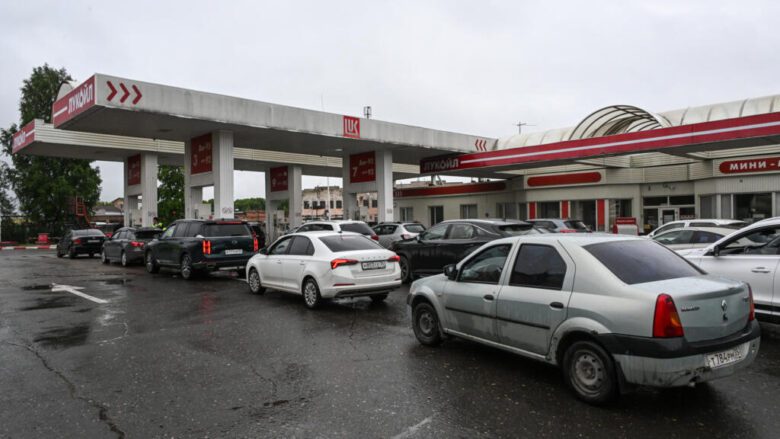
Russia’s growing fuel shortage has exposed one of the clearest contradictions in its wartime economy. The country remains one of the world’s largest oil producers, yet motorists in many regions have faced long queues, purchase limits and stations unable to supply some grades of petrol.
Russia is not running out of crude oil. The immediate problem lies in the refineries that turn it into petrol and diesel.
Ukrainian strikes hit Russia’s refining network
Ukraine has expanded its campaign against Russian refineries, storage depots and fuel transport infrastructure. The Associated Press counted more than 50 reported attacks on energy facilities in Russia and Russian-occupied Crimea between March and the end of June 2026. Several sites were struck more than once.
The damage has begun to affect domestic supply. According to AP, Russian crude processing in June was about 25 percent lower than a year earlier, while petrol production fell by roughly 17 percent. Shortages and rationing were reported across more than half of Russia’s regions, including areas far from the damaged refineries.
Energy Intelligence estimated on June 11 that around 2.14 million barrels per day—nearly one-third of Russia’s primary refining capacity—was offline because of Ukrainian drone attacks. Refinery runs fell below four million barrels per day during the first week of June, their lowest level in 21 years. This is an industry estimate rather than an official Russian figure, but later assessments suggested that the disruption had continued to deepen.
Repairing a damaged refinery is more difficult than replacing a storage tank. Many installations depend on specialised equipment, technical expertise and imported components that have become harder to obtain under Western sanctions. Repeated attacks also create the risk that repaired units will be hit again.
Moscow has restricted fuel exports and considered additional imports to protect the domestic market. President Vladimir Putin has acknowledged a fuel shortage, although he described it as limited and said the authorities were working to restore production.
Wartime spending is squeezing the wider economy
Russia absorbed the first economic shock of the invasion through energy revenue, extensive state spending and the rapid expansion of military production. That model kept factories operating and employment high, but it also redirected labour, credit and industrial capacity away from civilian sectors.
The Russian Economic Development Ministry cut its 2026 growth forecast from 1.3 percent to 0.4 percent. Forecasts for 2027 and 2028 were also reduced, reflecting weaker investment and slower activity outside industries supported by the state.
Russia’s Finance Ministry reported a federal budget deficit of 5.731 trillion rubles during the first half of 2026, equivalent to 2.5 percent of gross domestic product. The figure was 2.345 trillion rubles higher than in the same period a year earlier.
Borrowing conditions remain restrictive. The Bank of Russia reduced its benchmark interest rate to 14.25 percent in June but warned that inflation risks and fiscal pressures remained high. Such rates make investment and refinancing more expensive for businesses that do not benefit directly from military procurement.
Fuel shortages add pressure beyond the energy industry. Higher petrol and diesel costs can move quickly through freight transport, farming, food distribution and public services. The impact is especially important during the summer agricultural season, when demand for diesel rises.
Economic strain is becoming visible in Russian society
The shortages do not mean Russia is on the verge of mass unrest. The Kremlin retains extensive control over television, political organisation and public protest. Military salaries, compensation payments and defence-sector employment have also raised incomes for parts of the population.
The social cost of the war, however, is becoming more difficult to keep at a distance.
Levada Center’s consumer sentiment index fell to 94 points in June, dropping below 100 for the first time since October 2022. A reading below 100 means negative assessments of economic conditions outweigh positive ones. The index has fallen sharply over the past year as expectations about household finances and major purchases have weakened.
Fuel queues alone are unlikely to create a political breaking point. Their importance is that they translate the war into an everyday experience. The consequences are no longer confined to military budgets, casualty reports or distant regions near the Ukrainian border. They can now be seen at filling stations and felt in household expenses.
Russia still has the oil and financial resources to continue the war. But maintaining a permanent war economy is becoming more expensive, while the protection it once offered ordinary Russians from the conflict’s domestic effects is beginning to weaken.
Cover Image Credit: France 24