
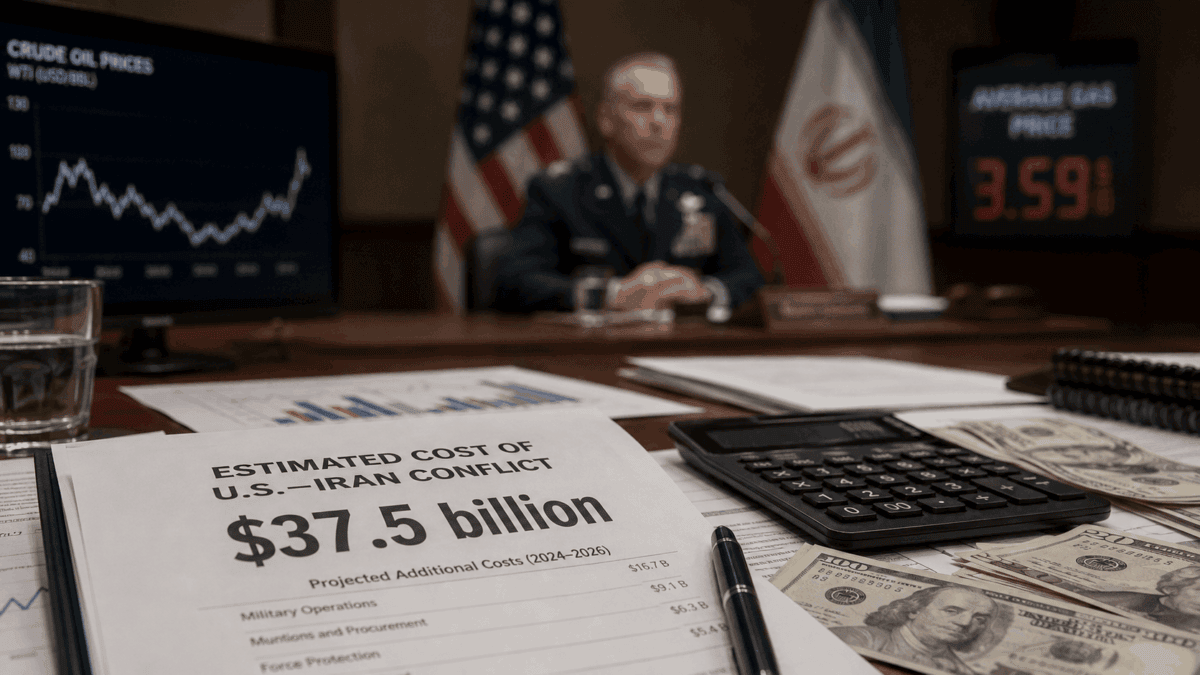
The United States has spent an estimated $37.5 billion on its war with Iran, according to Defense Secretary Pete Hegseth. While the figure reflects the direct cost of military operations, the wider economic bill is already reaching far beyond the Pentagon.
Hegseth disclosed the amount during a Senate Appropriations Committee hearing after Democratic Senator Dick Durbin asked how much the conflict had cost.
The estimate covers current military spending and projected costs through September 30. The Trump administration is also seeking nearly $90 billion in additional funding, much of it connected to the Iran war, depleted ammunition stocks and the need to maintain US military operations.
That money will help replace missiles, interceptors and other weapons used during the conflict. It will also generate new contracts for some of the world’s largest defense companies.
Weapons used in war must be replaced
Every missile launched creates another order for the defense industry.
The US government has been pushing manufacturers to expand production as the Iran war and other conflicts place increasing pressure on American weapons stockpiles.
Plans involving Lockheed Martin are expected to sharply increase production of Patriot PAC-3 and THAAD interceptors. RTX is also under pressure to produce more Tomahawk cruise missiles and AMRAAM air-to-air missiles.
For the companies involved, these contracts can mean years of guaranteed demand. Factories expand, suppliers receive new orders and investors benefit from rising defense spending.
This does not mean that the United States as a whole makes money from the war.
The contracts are funded through the federal budget or additional government borrowing. Most of the revenue flows to a relatively small group of defense manufacturers, suppliers and shareholders, while the cost is spread across taxpayers.
The public budget carries the cost
Military spending can support jobs and accelerate investment in aerospace, artificial intelligence and autonomous systems. But weapons consumed in combat do not produce the same long-term public benefit as housing, hospitals, transport systems or civilian infrastructure.
Once a missile is fired, it must be replaced. The government pays twice: first to use the weapon and then to rebuild the stockpile.
The $37.5 billion spent so far also carries an opportunity cost. Money directed toward military operations cannot simultaneously fund health care, education, housing or other domestic programs.
Senator Patty Murray raised this issue during the hearing, accusing the Trump administration of finding money for another war while arguing that resources for health care, child care and housing remain limited.
She also criticized President Donald Trump for entering the conflict without congressional authorization and without clearly explaining its long-term objectives.
Hegseth defended the additional funding request, warning that the Pentagon could otherwise struggle to pay personnel, replace equipment and maintain military readiness.
Oil prices spread the bill worldwide
The economic consequences are not limited to the United States.
The war has affected the Strait of Hormuz, one of the world’s most important oil and gas routes. Before the conflict, about one-fifth of global oil supplies passed through the strait.
Even the threat of disruption can raise oil prices, shipping costs and insurance premiums. Those increases quickly move through the wider economy.
More expensive oil raises the cost of road transport, aviation, agriculture, fertilizer, plastics and industrial production. Companies pass part of those costs to consumers through higher prices.
The result is that people in countries with no direct role in the war may still pay more for fuel, food, transport and electricity.
Higher energy prices could also make it harder for central banks to reduce interest rates. That would keep borrowing costs elevated for households and businesses, adding another layer to the war’s economic impact.
A concentrated profit and a widely shared cost
The Iran war has created a clear economic divide.
Defense companies receive large contracts and predictable demand. Military factories may hire more workers, and investment in weapons technology may accelerate.
The wider public faces a different outcome: greater government borrowing, pressure on domestic spending and higher energy prices.
Hegseth’s $37.5 billion figure is therefore not the final cost of the war. It is only the amount currently visible in Pentagon spending.
If the conflict continues, defense contractors will likely receive more orders. The financial burden carried by taxpayers, consumers and the global economy will also continue to grow.