
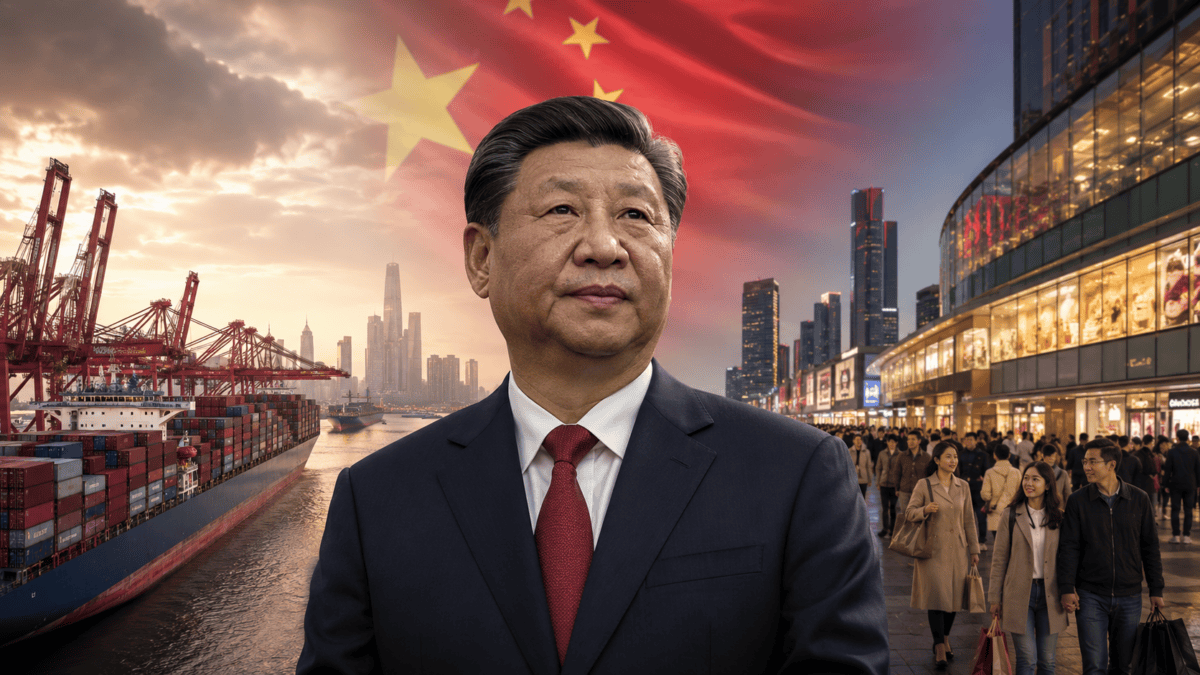
At first glance, President Xi Jinping’s latest call to strengthen domestic demand sounds like another routine response to China’s slowing economic growth.
It is potentially far more consequential.
The July 30 meeting of the Communist Party’s Politburo, chaired by President Xi Jinping, acknowledged mounting economic difficulties and pledged to accelerate government spending, introduce additional support measures and strengthen domestic demand during the second half of 2026. Yet Beijing stopped short of announcing a major stimulus package.
The language was cautious. The problem it exposed was not.
China became an economic superpower by building factories, directing capital toward infrastructure and supplying consumers across the world. Now, as trade tensions, tariffs and geopolitical rivalry threaten access to foreign markets, Beijing is under growing pressure to create a second source of power: a Chinese population wealthy and confident enough to buy much more of what the country produces.
The radical idea is not that China should encourage consumption. Beijing has said that for years.
The radical question is whether China is prepared to change the distribution of income, security and economic influence required to make it happen.
An Old Strategy Enters a More Dangerous Era
Xi’s emphasis on domestic demand is not a sudden policy reversal.
Since 2020, China has promoted the strategy known as “dual circulation,” under which domestic and international markets reinforce one another while the domestic economy serves as the main pillar. Chinese officials have repeatedly stressed that the strategy does not mean abandoning international trade or constructing a closed economy.
What has changed is the environment surrounding that strategy.
Tariffs, export controls, supply-chain restrictions and increasingly open industrial competition between China and Western economies have made dependence on foreign demand more politically dangerous. The International Monetary Fund warned earlier in 2026 that tariffs and trade-policy uncertainty were likely to weigh on Chinese growth, while renewed trade tensions remained a major external risk.
China is therefore not trying to withdraw from the world economy. It is trying to reduce the ability of disruptions in foreign markets to destabilize growth at home.
In strategic terms, a stronger Chinese consumer base could function almost like economic infrastructure. A sufficiently large domestic market would give Chinese companies somewhere to sell goods when foreign governments raise barriers, restrict technologies or attempt to reorganize supply chains away from China.
Consumption would no longer be merely an economic indicator. It would become part of national resilience.
The Imbalance Is Becoming Harder to Ignore
China’s latest economic figures reveal why this debate has become urgent.
The economy grew by 4.3 percent year on year in the second quarter of 2026, down from 5 percent during the first quarter. Growth for the first half of the year stood at 4.7 percent.
Industrial and technological production remained comparatively strong. High-tech manufacturing expanded by 13.3 percent during the first six months of the year, while exports increased by 13.4 percent in yuan terms. June exports rose by 20.8 percent from a year earlier.
Domestic spending presented a very different picture.
Retail sales increased by only 1.3 percent during the first half of 2026 and by just 1 percent in June. Fixed-asset investment fell by 5.7 percent, private investment declined by 8.5 percent and property investment dropped by 18 percent.
China’s National Bureau of Statistics described the imbalance between strong supply and weak demand as acute.
That is the central contradiction facing Beijing. China can manufacture electric vehicles, batteries, machinery, solar equipment and advanced electronics at enormous scale. But its domestic market is not expanding quickly enough to absorb the country’s productive capacity.
Exports can compensate for that weakness temporarily. They can also intensify resistance abroad, particularly when foreign governments believe Chinese overproduction is placing their own industries and employment under pressure.
The stronger China’s factories become, the more urgently Beijing needs Chinese households to become stronger consumers.
The Radicalism Lies Beneath the Slogan
China has now adopted its first five-year plan dedicated specifically to expanding consumption. The plan aims to raise retail sales to around 60 trillion yuan by 2030 and significantly increase household consumption as a share of gross domestic product.
The target is ambitious because household consumption has remained at roughly 40 percent of China’s GDP—low compared with the levels seen in many major consumer economies.
Changing that ratio requires much more than discounts on cars, appliances or restaurant meals.
Households tend to save heavily when they are uncertain about employment, property values, medical costs, education and retirement. Encouraging them to spend more therefore requires stronger wages, pensions, healthcare, unemployment protection and public services.
This is where an apparently ordinary policy objective begins to carry radical implications.
China’s traditional development model has directed enormous resources toward state-backed investment, local governments, infrastructure, property and industrial capacity. A genuine move toward consumption-led growth would require a larger share of national income and public spending to reach households directly.
That does not necessarily mean dismantling China’s state-directed economic system. It could, however, require altering its priorities.
The IMF has recommended that China shift fiscal support toward consumption and away from inefficient investment, arguing that a consumption-led growth model should become the country’s overarching economic priority. It also noted that the measures introduced so far remained modest compared with the scale of the challenge.
In other words, making Chinese consumers more powerful could reduce the dominance of institutions that benefited most from the old investment-heavy model.
Beijing Has Diagnosed the Problem—but Not Yet Crossed the Line
The July Politburo meeting did not announce a dramatic redistribution of income or a large direct transfer to households.
Instead, the leadership promised faster fiscal spending, incremental support, measures to stabilize employment and property, and further action against “involution”—the destructive price competition that has reduced profits across parts of Chinese manufacturing.
This suggests Beijing remains cautious.
China’s leaders appear to recognize that the old formula of property, infrastructure and exports cannot indefinitely carry the economy. They also remain committed to advanced manufacturing, technological independence and industrial scale—the foundations of China’s growing global influence.
The two objectives are not necessarily incompatible. But resources are limited, and the balance between them matters.
Supporting households on the scale required to transform consumption would involve more than economic management. It would affect how income is distributed, which sectors receive state support and who exercises economic power inside China.
That is why the latest statements should not be read merely as another promise to boost retail sales.
The deeper story is that the economic model behind China’s rise is colliding with the geopolitical conditions created by that rise.
China became powerful by building the world’s factory. Its next strategic challenge is deciding whether it is prepared to build the world’s largest consumer economy as well.