
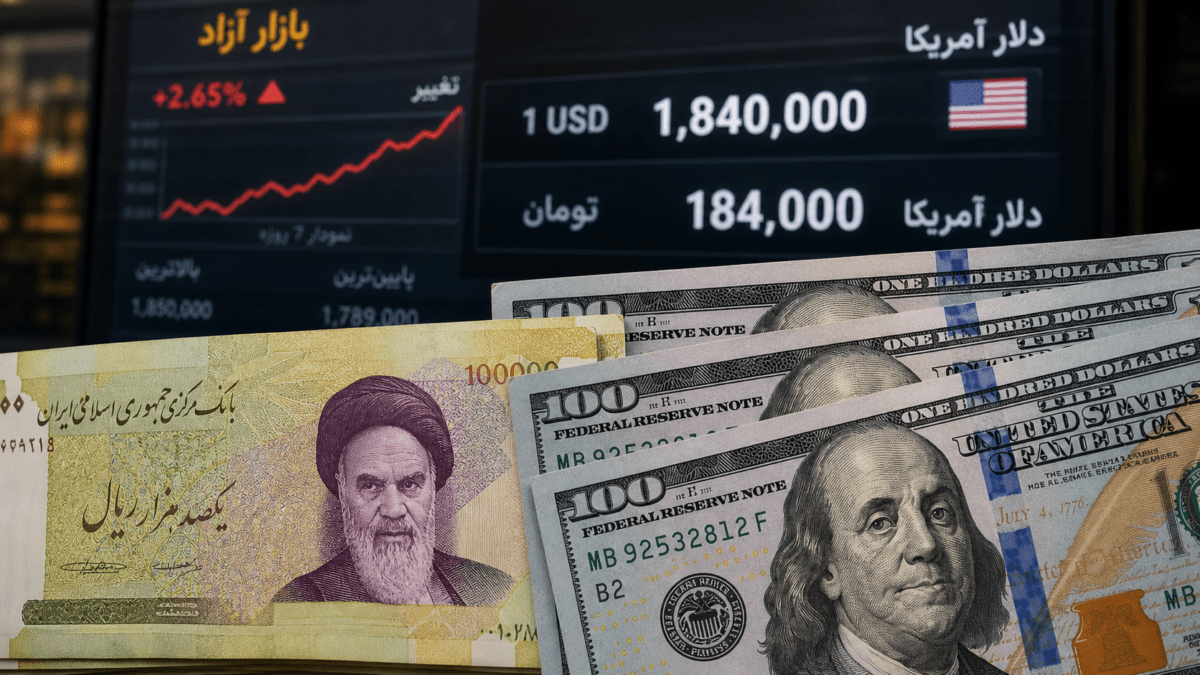
The U.S. dollar rose above 184,000 tomans in Iran’s free market, setting a new record low for the local currency.
Some live exchange-rate screens on May 3 placed the free-market rate closer to 188,000 to 189,000 tomans in certain listings. Since one toman equals 10 rials, that implies a rate near 1.88 million rials per dollar.
Before U.S.-Israeli strikes on Iran began on February 28, the dollar was trading around 160,000 tomans. The currency later recovered toward 135,000 tomans during parts of the conflict.
That recovery has now been erased. The renewed slide shows that the market is again pricing in sanctions pressure, weaker foreign-currency inflows and the cost of war damage.
The pressure is visible in the open market first because that is where households and businesses react fastest. A weaker rial makes imports more expensive. It raises the cost of food, medicine, industrial inputs and consumer goods. It also feeds inflation expectations, which can become self-reinforcing when people rush to protect savings in dollars, gold or other hard assets.
Reports last week showed Iran’s rial had already fallen to a record low of about 1.81 million rials per dollar, with demand for hard currency rising after the ceasefire with the U.S. and Israel. Iran’s central bank also reported year-on-year inflation of 65.8% for the Iranian month running from March 20 to April 20.
Iran also faces a supply-side problem. War damage has affected parts of the economy and forced Tehran to suspend some steel and petrochemical exports. These sectors are important sources of foreign currency for an economy already constrained by sanctions.
The market is also showing confusion over real pricing. Some platforms showed the dollar at 183,000 to 184,000 tomans, while some street-market reports pointed to lower rates near 154,000 tomans. That gap reflects a fragmented currency system where official, semi-official and free-market prices can diverge sharply.
A record dollar rate signals that households, traders and importers are preparing for more instability. That can reduce domestic purchasing power, raise business costs and deepen pressure on public finances.